


What is lead qualification, and where it happens in outbound
In short
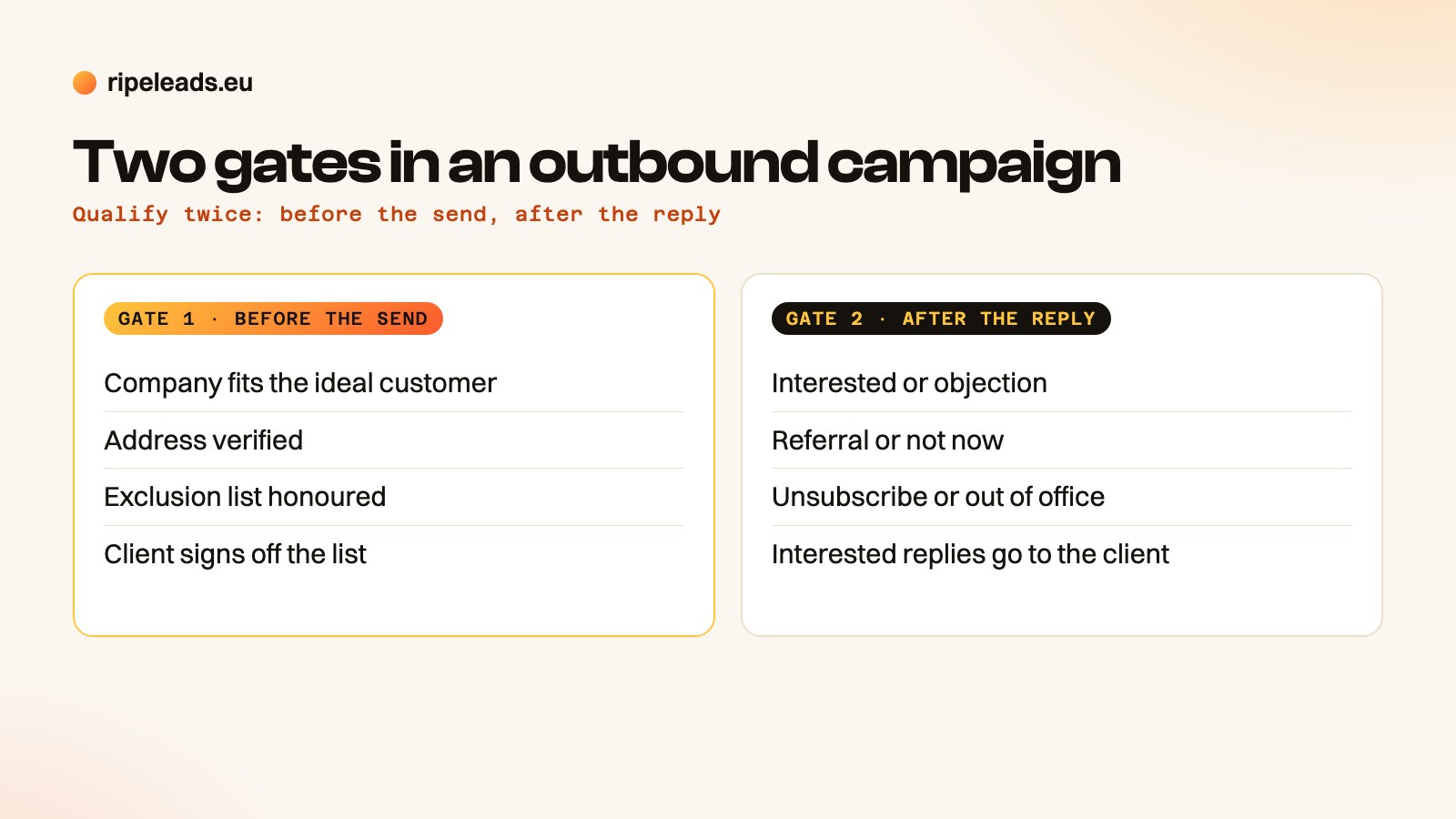
Lead qualification is the process of deciding whether a contact is worth a salesperson's time, based on how well they fit your ideal customer and how likely they are to buy. It usually runs through a framework such as BANT, CHAMP or MEDDIC. In outbound, where you choose the contact yourself, qualification happens twice: once before the first email is sent, and again when a reply comes in.
On this page
Lead qualification, defined
Lead qualification is the step between "someone could buy" and "someone gets a salesperson's time". You compare a contact against criteria for fit and intent, then route it: pursue now, nurture for later, or drop. The criteria come from your ideal customer and from what a buyer has to have in place before a sale is realistic.
Most guides describe qualification for inbound leads: a form fill or a demo request arrives and someone decides what to do with it. Outbound reverses the order. You pick the contact first, so the question starts earlier, and that is why this page treats it as two gates rather than one.
Qualification gets confused with its neighbours. The table separates them by the question each one answers.
| Term | Question it answers | Who runs it |
|---|---|---|
| Lead generation | Who could we talk to? | Marketing or an outbound team |
| Lead validation | Is this contact real and reachable? | Data checks, such as address verification |
| Lead qualification | Is this contact worth a salesperson's time? | Marketing, an SDR or the seller |
| Lead scoring | How do we rank contacts against each other? | A points model, often inside the CRM |
| MQL and SQL | Which funnel stage is this lead in? | Marketing and sales together |
Scoring is one method inside qualification, covered in our lead scoring guide. MQL and SQL are the stage labels qualification produces, explained in MQL and SQL explained.
The lead qualification process in five steps
The order is the same whether a person or a tool does the work.
- Gather the data. Company, role, size, market and how the contact reached you or why you chose them.
- Check fit. Compare the company and the person against your ideal customer profile. A miss here ends the process.
- Check intent. Look for a reason to talk now: a stated need, an open vacancy, a reply, a visit to a pricing page.
- Ask the qualifying questions. The call or the email thread tests need, authority, money and timing.
- Route. Ready for a salesperson, worth nurturing, or drop.
Steps one to three can run on data before anyone speaks to the contact. Step four needs a conversation. In outbound the two halves land on opposite sides of the send, which the next sections come back to.
Lead qualification frameworks compared
A framework is a checklist of what must be true before a lead moves forward. The three that come up most are BANT, CHAMP and MEDDIC. The fourth row is the minimum check we use for cold outreach, where you know little about the contact before the first email.
| Framework | Letters | Best for | Weak spot |
|---|---|---|---|
| BANT | Budget, authority, need, timeline | Fast checks on simple, lower-value sales | Opens with budget, which can stall a first conversation |
| CHAMP | Challenges, authority, money, prioritisation | Conversations that start from the buyer's problem | Needs a real discovery conversation to fill in |
| MEDDIC | Metrics, economic buyer, decision criteria, decision process, identify pain, champion | Long, multi-person, high-value sales | Too heavy to apply to a cold list |
| Fit and signal | Does the company match, and is there a reason to write now? | The first email in cold outreach | Says nothing about authority or money, so it cannot replace the others after a reply |
The verdict is simple. Use BANT or CHAMP when the deal is small enough for one conversation. Use MEDDIC when several people sign. Use fit and signal to decide who gets the first email, then switch to one of the three once someone answers.
Qualification questions that work
These are questions you ask a prospect on a call or in a thread, grouped by what each one tests. Fields on a form do not do the same job, because a form cannot follow up on a vague answer.
Need
- What are you doing about this today?
- What happens if nothing changes this year?
Authority
- Who else has a say in this decision?
- Have you bought something like this before, and how did that go?
Money
- Is there a budget for this, or would it need to be found?
- What would you compare the cost against?
Timing
- What is driving the date, if there is one?
- What would have to happen first?
Ask them as a conversation, not as a run of eight in a row. Two or three answered well tell you more than all eight answered thinly.
Gate 1 in outbound: qualify before you send
In outbound the lead did not raise a hand. You chose the company, so the first qualification happens before any email leaves. Gate 1 asks whether this company and this person are worth contacting at all, and it is answered from data, not from a conversation.
At Ripe Leads, Gate 1 spans two steps of the service. The list is built in the Collect step from public registers and job boards; the Qualify step then verifies every address, honours the client's exclusion list, and the client signs off the list.
Three parts of that matter for any team doing this itself. The fit rules need writing down first, which is the work in how to define your ICP. A clean address list protects the sending domain, and the mechanics are in our guide to email bounce rate, linked below. The source of the data decides what you may do with it, and how we source prospect data under GDPR sets that out.
A contact that fails Gate 1 never receives an email. That is cheaper than finding out from a bounce, an unsubscribe or a silence.
Gate 2 in outbound: qualify the reply
Gate 2 opens when someone answers. A reply is not yet a qualified lead. It is a message that has to be read and sorted. The six classes are the ones listed in our guide to AI in B2B lead generation, linked below.
| Reply | What it means | What happens next |
|---|---|---|
| Interested | The person wants to talk or asks a buying question | Goes to a person at once, with the thread attached |
| Objection | Interest with a concern attached | A person answers the concern and judges whether it is real |
| Referral to a colleague | Wrong person, right company | Contact the colleague named, and note who referred you |
| Not now | The need exists but the timing does not | Nurture, with a date to come back |
| Unsubscribe | The person wants no further mail | Remove them from every sequence |
| Out of office | No information about interest | Wait and keep the contact in the sequence |
On our campaigns, replies from every campaign land in one shared inbox where AI labels each one, and every interested reply is forwarded to the client's inbox with the thread attached. What to do with an interested reply is its own topic, covered in what to do when a prospect replies yes.
The filter shows in our published campaign numbers. In our campaign results report, read on 20 September 2026, a reply is any answer and a positive reply is one the client marked in the sending tool as worth a conversation. The strongest campaign took 425 replies and 297 were positive, 69.8%. A run of eight campaigns for the same client took 341 replies and 202 were positive, 59%. A precast and facade manufacturer's run took 66 replies and 13 were positive, closer to one in five. The report calls the gap between replies and positive replies the number to watch before the headline reply rate.
Who should qualify leads?
Marketing qualifies on fit and activity, an SDR qualifies on the conversation, and the seller qualifies on the deal. With an inbound flow the three are separate hand-offs. In outbound they often collapse into one person or one service, because the same person who chose the list reads the replies.
If you are deciding who should hold the job, what an SDR is and what the role costs covers the human option, and AI SDR vs human outbound covers which qualification steps software handles well. Reply labelling is one of them. Deciding who belongs on the list, and judging an objection, are not.
Common qualification mistakes
Rejecting "not now" as "no". A prospect with a real need and a bad quarter is a nurture lead. Treat the two classes as one and you discard the contacts most likely to buy later.
Treating every reply as a lead. Out-of-office messages, unsubscribes and polite refusals all count as replies. Read each one before it enters the pipeline.
Qualifying on company size alone. Size is easy to filter on and weakly tied to need. A mid-sized company with an open vacancy for the role you replace is a better fit than a larger one with no signal.
Asking all the questions at once. Qualification that feels like an interrogation ends the conversation it was meant to open.
The funnel behind qualification is in B2B sales funnel stages. Authority is one part of qualification; see mapping the buying committee in B2B deals.
Frequently asked
What is lead qualification?
What is the difference between lead qualification and lead generation?
What are the most common lead qualification frameworks?
What is the difference between lead qualification and lead scoring?
When should you qualify a cold outreach lead?
What counts as a qualified lead at Ripe Leads?
Want both gates handled for you?
We build and verify the list, run the sequence and sort the replies. You sign off the list, and every interested reply lands in your inbox with the thread attached. See the pricing or book a short strategy call.
Book a strategy call Or get a free target list first