


AI SDR vs human outbound: what an AI SDR does, and what a person still has to do
In short
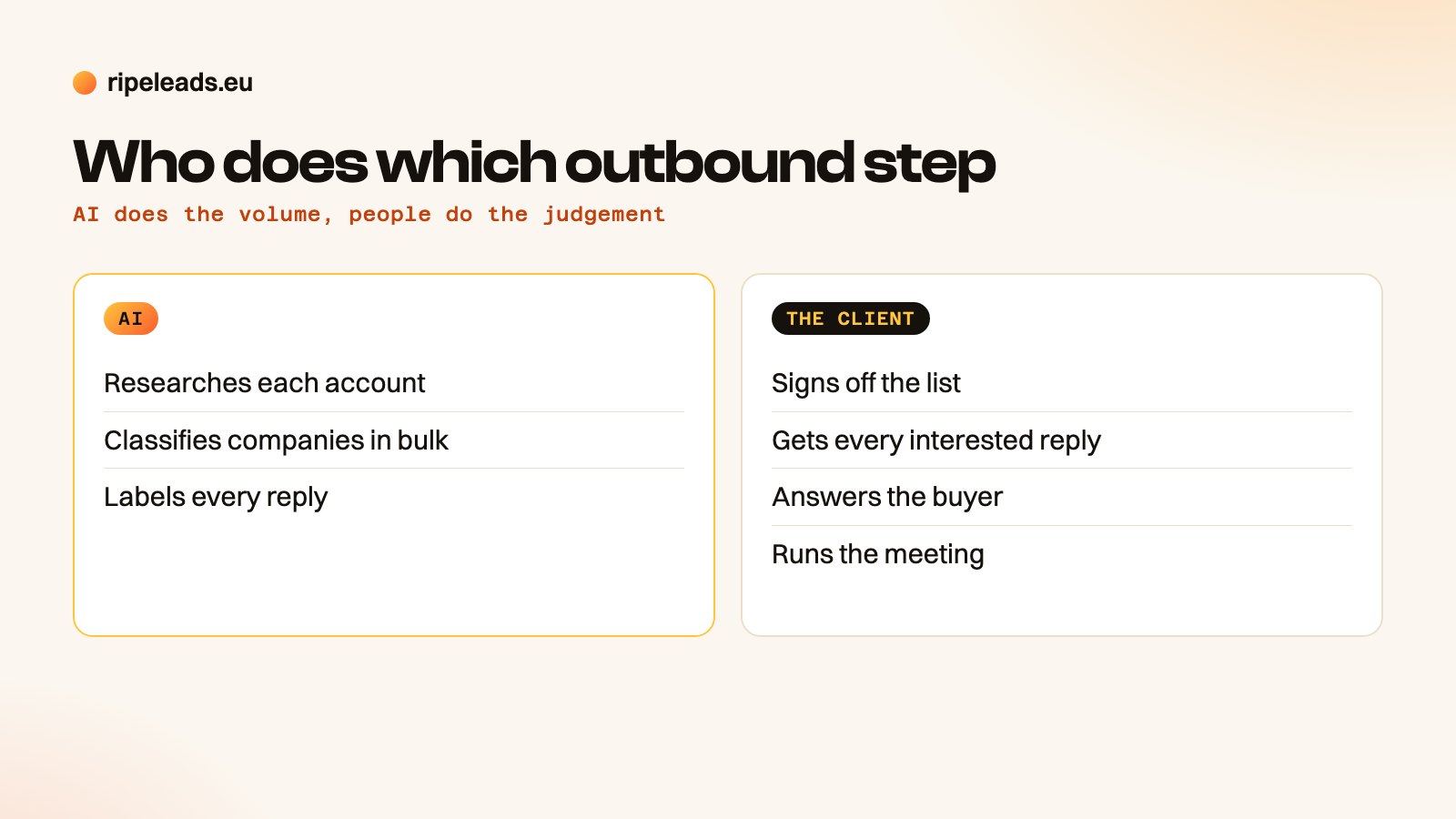
An AI SDR is software that runs the early steps of outbound sales on its own: it researches accounts, writes and sends messages, follows up and sorts replies. It does the volume work well and the judgement work badly, so the real choice is which steps you hand over, not AI or human. At Ripe Leads, AI handles research, company classification and reply labelling, while the client signs off every list and every interested reply goes to the client's inbox.
On this page
What is an AI SDR?
An AI SDR is software that does the first-contact work of a sales development representative. SDR stands for sales development representative, the person who finds prospects, writes to them and sorts the replies before a salesperson takes over. The AI version does those jobs without a person at the keyboard.
You will also see the phrase "AI SDR agent". That usually means the same product with one extra property: it chains the steps together and acts without a person approving each message. A tool that only drafts an email for you to review is an assistant. A tool that picks the account, writes the email and sends it is the agent version.
The human role it imitates is covered in what an SDR is, what the job costs and the alternatives. This page compares the two on the steps of a real campaign, because that is where the decision gets made.
How does an AI SDR work, step by step?
An AI SDR runs the same sequence a person would, in the same order. It takes a list of companies or finds one, reads their websites and public pages, writes a message for each, sends it from a connected mailbox, sends follow-ups on a timer, reads the replies and tags them as interested, not now, not interested or out of office. Some tools then propose a meeting time.
Each step is pattern work, which is why software handles it quickly. The weak points sit where a step needs a decision rather than a pattern: whether the company belongs on the list at all, whether a fact in the message is true, and what to say to a buyer who pushes back. The next section splits the steps one by one.
AI SDR vs human SDR vs done-for-you outbound
The table runs through nine steps of one outbound campaign. The first two columns describe each approach in general terms. The last column states what we run at Ripe Leads, taken from our stack page and our pricing page, nothing more.
| Step | AI SDR tool | Human SDR | What we run at Ripe Leads |
|---|---|---|---|
| Account research | Fast and shallow, can state facts that are not true | Slow, reads context | Claude Code researches each account |
| List building | Pattern matching at volume | Manual, small lists | Public registers, company websites and job adverts first, AI classifies the companies |
| List sign-off | Rarely a step | The manager | The client signs off the list |
| Sending infrastructure | Depends on the tool | The company mailbox | Dedicated domains we register, SPF, DKIM and DMARC on each, two weeks of warm-up |
| Copy | Generated per prospect | Written per segment | Written in the buyer's language |
| Follow-ups | Automatic | Manual, tends to drift | A sequence run by the sending platform |
| Reply labelling | Strong | Slow | AI labels each reply in a shared inbox |
| Reply conversation | Weak and risky | Strong | Interested replies are forwarded to the client |
| The meeting | None | Strong | The client's job, outside what the retainer covers |
Read the table for risk first. AI is strong where the step repeats and weak where the step needs a judgement a buyer will notice. A human SDR is the reverse. A done-for-you setup splits the steps so that software takes the repeating ones and the decisions stay with people who answer for them. Our retainer is EUR 3,750 for the first month including setup and then EUR 2,850 a month, tools and data included, as listed on that pricing page.
Where do AI SDRs break?
Deliverability. An AI SDR makes sending cheap, so the temptation is volume. Volume with generic copy is what pushes sender domains toward spam folders, and a damaged domain carries its reputation into the next campaign. The mechanics are in why cold emails go to spam.
Invented facts. A model that personalises a line has to get the fact from somewhere. When the fact is missing, some models fill the gap. One wrong "congratulations on the funding round" tells the reader the whole message was machine-made. Personalisation that holds up starts from a source a person can click, which is the argument in cold email personalisation at scale.
The list. This is the failure vendors do not describe. In a small European market, the addressable list is short. An autonomous sender contacts all of it once, badly, and you cannot contact the same companies again with a better offer. The salary an AI SDR saves is small next to a market that has already read your weakest email. Lead generation in France: what works in 2026 covers why the visible output of an SDR is the part AI automates well and the invisible output is the part that produces revenue.
What we automate and what we do not
This is our own split, as published on the stack page. Claude Code builds the lists and researches each account. Gemma and Qwen are open models that run on our own machines, one classifying companies in bulk and the other sorting and labelling long lists. Replies from the campaign land in one shared inbox, where AI labels each one. The client gets every interested reply.
Three things stay with people. The client decides which companies are on the list, because the client signs it off. The conversation after an interested reply belongs to the client, because every interested reply is forwarded to the client's inbox. The meeting is the client's job too, and sits outside what our retainer covers. We describe this split as a working practice, not as a result.
When is an AI SDR the right call?
An AI SDR earns its place in four situations. The offer is low in value and high in volume, so one bad message costs little. Inbound enquiries need an answer in minutes, not hours. The team already owns clean sending infrastructure and a large list that it can afford to wear out. The market is big enough that a burned segment is replaceable.
Outside those four, the case weakens. A European B2B seller with a short, defined list, several languages and a high-value offer is the opposite profile. For that seller the cost question is better answered with the in-house versus agency cost comparison, which includes the hybrid option many teams miss.
Do European rules change when a model sends the email?
No. Data protection and electronic communications rules look at who you contact and for what purpose. They do not look at the tool that sends the message. An AI SDR sending to the wrong people breaks the same rules a person would, and the sender stays responsible. Our guide to GDPR-compliant cold email in Europe sets out the legal basis, what it requires and where enforcement differs by country.
How to test an AI SDR before you commit
Pick one segment and keep the first send small. Send from a fresh domain, never your main one, and put a few seed inboxes on the list to see where the mail lands. Set a stop rule before you start, for example pausing if replies stay at zero after the first full sequence. Judge the test on interested replies, not on emails sent.
The table shows the counts to track and the usual trap for each. In our own campaign reporting a reply is any answer, and a positive reply is one the client marked as worth a conversation. The campaign results PDF states the denominator beside every rate.
| What to count | The AI SDR trap | The fix |
|---|---|---|
| Emails sent | Dashboards lead with it, and it rises with volume whatever the result | Treat it as cost, never as output |
| People reached | Follow-ups to one person inflate the sends | Count people who received at least one email |
| Replies | Out-of-office and "stop" count as replies | Read the replies, do not trust the total |
| Interested replies | An automatic label can mark a polite refusal as interest | A person reads each one before it counts |
For the human-versus-software line, see sales automation examples.
Frequently asked
What is an AI SDR?
Can an AI SDR replace a human SDR?
Is an AI SDR cheaper than a human SDR?
Do AI SDRs hurt email deliverability?
Do you use AI at Ripe Leads?
Is AI SDR outreach legal in Europe?
Does an AI SDR actually work?
Want the repeating steps automated and the decisions kept?
We run targeting, data, copy and follow-up as a done-for-you service. AI does the research and the reply labelling, you sign off the list, and every interested reply goes to your inbox. See the pricing or book a short strategy call.
Book a strategy call Or get a free target list first