


B2B contact list: build your own, or buy one?
The short answer
Build your B2B contact list against your own ideal customer profile instead of buying one. Source companies from public registries and company websites, match real people to roles on LinkedIn, verify every address before sending and keep the list narrow. A few hundred right-fit contacts out-produce thousands of loosely matched ones on replies and on sender reputation. Bought lists come stale, with high bounce rates and no provenance.
Every outbound campaign rests on its list. Good copy cannot rescue a bad one, and a good list quietly makes average copy look clever.

On this page
- It starts with the ICP, not the tool
- Where the data actually comes from
- Build vs buy: B2B contact lists compared
- Why buying a big list usually backfires
- Verification is not optional
- Small and accurate wins
- Keep it clean over time
- A list-building workflow, step by step
- Prospect research: one hook per contact
- Numbers worth knowing before you send
- Common list-building mistakes
- If you are thinking a bigger list cannot hurt
- Building lists for European and DACH markets
- Frequently asked
It starts with the ICP, not the tool
Before sourcing anything, you need criteria. Your ideal customer profile tells you which industries, company sizes and roles belong on the list. Without that filter, sourcing just produces volume, and volume is the problem, not the goal.
Where the data actually comes from
For European B2B, the reliable sources are more boring than most tools suggest:
- Public business registries, the base layer of company data in most EU markets.
- Company websites, where roles and public contacts are published.
- LinkedIn and Sales Navigator, the best way to match a real person to a role.
- Specialist databases, useful for firmographics and filtering at scale.
Build vs buy: B2B contact lists compared
The table compares the two routes on the points that decide results. The sources behind a built list come first.
| Point | Build against your ICP | Buy from a data vendor |
|---|---|---|
| Data source | Public business registries, company websites, LinkedIn and Sales Navigator, specialist databases for firmographics | A vendor database of unknown provenance |
| Targeting | Criteria written down first; each one checkable | Loose; whatever filters the vendor offers |
| Freshness | Built for this campaign and verified before sending | Tends to be stale |
| Bounce rate and deliverability | Verified addresses keep bounces in the low single digits | High enough to damage the sending domain |
| Compliance | You can say where each contact came from and on what basis you contact them | You inherit a question you cannot answer |
| Fit for copy | A narrow list lets you write something specific | A broad list forces generic copy |
Lists decay, so refresh and retire data on a schedule, and see GDPR-compliant cold email for the legal basis.
Why buying a big list usually backfires
A cheap list of thousands is tempting and almost always a false economy. The data tends to be stale, the targeting loose, and the bounce rate high enough to damage the domain you send from.
You also inherit a compliance question you cannot answer: where did these contacts come from, and on what basis are you contacting them. For European outbound that matters, see our note on GDPR-compliant cold email.
Verification is not optional
Tools often guess addresses from a name and a domain pattern. Some guesses are wrong, and wrong addresses bounce. A high bounce rate tells mailbox providers you are not a careful sender, and your delivery suffers across the whole domain.
Verify before you send. It is the cheapest insurance in outbound.
Small and accurate wins
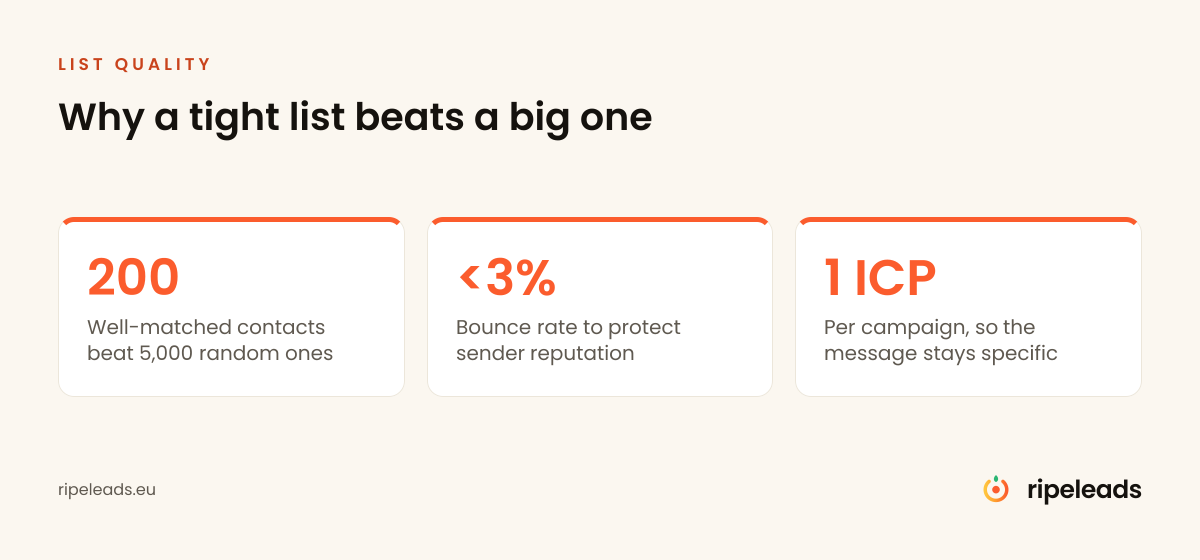
Intuition says more contacts means more replies. In practice the opposite holds. A narrow list lets you write something specific, keeps bounce low, and protects deliverability.
A broad list forces generic copy, and generic copy is exactly what people delete without reading.
Keep it clean over time
Lists decay. People change roles, companies restructure, addresses die. Anyone who asks not to be contacted comes off the list immediately and stays off. That is both good practice and a legal requirement in Europe. The mechanics of refreshing and retiring data are covered in list decay and maintenance.
A list-building workflow, step by step
- Write the criteria down. Industry, headcount range, geography, the two or three roles that own the problem you solve. If a criterion cannot be checked, it is not a criterion.
- Build the company list first. Source companies matching the firmographics before you look for any person. This is where registries and databases do the heavy lifting.
- Match people to roles. For each company, find the actual holder of the target role, usually via LinkedIn. A job title in a database is a claim; a current profile is closer to evidence.
- Find and verify the address. Source the email, then run it through verification. Discard or flag anything that does not verify cleanly.
- Enrich with one usable detail per contact. A trigger, a recent change, a specific fact. This is what turns a row into a sendable email, and a clean source underneath makes the detail trustworthy. For one market in depth, see B2B lead generation in Poland.
- Segment before sending. Split by role, industry or trigger so each group gets copy written for it, not around it.
Prospect research: one hook per contact
Research is what makes an email relevant, and unbounded research eats the day. Hunt for one usable hook per contact, not a dossier, and give each prospect a fixed few minutes.
Work the same sources in the same order: the person's LinkedIn for role, tenure and recent changes, then the company site and news for what changed lately, then a trigger check such as open roles or a new location. A good hook is specific, true and connected to the problem you solve, such as a recent hire that implies the problem or an expansion that creates the need. Skip the generic congratulations opener, which proves nothing.
Three minutes on an operations director at a mid-sized logistics firm might look like this. LinkedIn shows she joined eight months ago. The company site announces a second distribution centre. The careers page lists four open warehouse supervisor roles. The hook is the new site plus the hiring, and everything else you noticed stays unused.
Match depth to account value: a Tier 1 account earns deeper work, a Tier 3 gets a quick pass and segment relevance carries it. Research in batches, twenty prospects in one sitting with one recorded hook line each, then write the openers in the next block. Batches also show patterns, such as five companies on the list hiring for the same role, which becomes a segment angle. To turn a hook into an opening line, see cold email personalization at scale.
Qualify before you research, and keep to professional signals: holiday photos and family milestones do not belong in a B2B email. A contact with no quick hook gets a clean segment-level email, which beats a strained personal reference.
Numbers worth knowing before you send
Ranges vary by market and source, but some patterns hold. Verification will normally remove or flag a noticeable slice of any freshly sourced list; if it removes almost nothing, be suspicious of the verifier, not proud of the list. After verification, bounce rates should sit in the low single digits; sustained rates above that start damaging the sending domain. And B2B data ages fast: a meaningful share of any list goes stale within a year as people change jobs, which is why a list built last spring is a draft, not an asset. The full picture on what bounces do to a domain is in verification and bounce rate.
Common list-building mistakes
- Starting from the tool, not the ICP. Whatever filters the database happens to offer become the targeting. Define criteria first, then find sources that can express them.
- One contact per company. If your only contact ignores you, the account is dead. Two or three relevant roles per company keeps the door open without spamming the building.
- Trusting catch-all domains. Addresses on catch-all servers verify as "maybe" at best. Treat them as a separate, lower-volume segment rather than mixing them into the main send.
- Skipping the human check. Ten minutes of spot-checking fifty rows catches systematic errors, wrong country, wrong titles, a scraper gone sideways, before the campaign does.
- Never recording where data came from. When a contact asks how you got their details, and in Europe some will, you need an answer. Keep the source per row.
If you are thinking a bigger list cannot hurt
It can, and the damage is invisible until it is expensive. Every loosely matched contact you email lowers your reply rate, raises your complaint risk, and spends your domain's reputation on someone who was never going to buy. The sender reputation you burn on 2,000 wrong contacts is the same reputation your next, better-targeted campaign has to send from. Volume feels like progress because activity is easy to measure. Replies from right-fit buyers are the only number that pays.
Building lists for European and DACH markets
European list building has its own texture. Coverage in the big US-centric databases thins out fast outside the UK, especially for the DACH region, the Nordics and the Baltics, so local registries and manual sourcing carry more weight; our overview of where European B2B data comes from maps the options per market. German-speaking markets add formality: correct titles and clean company-name handling matter, and a list full of mangled umlauts signals carelessness before the first sentence is read; Germany also applies stricter cold email rules than the EU baseline. GDPR shapes the whole process, but it does not forbid B2B prospecting: publicly available business contact data, used for a relevant business purpose with a clear opt-out, is workable under legitimate interest. What it does forbid is exactly what bought bulk lists represent: data of unknown origin, used without accountability. Build narrow, verify everything, and record your sources, and the compliance question mostly answers itself.
Related: TAM analysis and market mapping, how to define your ICP, and how we source B2B data under GDPR.
See How to build a B2B cold email list in Australia for the fuller picture.
Frequently asked
How do you build a B2B contact list?
Where can I get B2B contact data in Europe?
Should I buy a B2B email list?
Is it better to buy from a business lead list company, or build the list yourself?
How important is email verification?
Why should I segment my outbound list?
How should I segment a B2B outbound list?
How much time should I spend researching a prospect?
What should I look for when researching a prospect?
We build the list for you
Targeting, sourcing and verification against your ICP, so campaigns start from clean data instead of a spreadsheet of guesses.
Book a strategy call Or get a free target list first