


How to define your ICP for outbound that actually lands
The short answer
An ICP describes the company you serve best, not the person. Define it by industry, size, maturity, budget and the specific problem you solve, then turn it into a real contact list and test it with a small campaign. The market answers faster and cheaper than any internal debate.
On this page
- What an ICP is, and what it is not
- ICP and buyer persona are different jobs
- How to build one when you already have customers
- How to build one when you do not
- Turn it into a list, or it stays theory
- Add disqualifiers, not just criteria
- Tier the list before you write a word
- Test before you scale
- Reading the test results honestly
- Common ICP mistakes and their fixes
- How this plays out across Europe
- The most common mistake
Most outbound that fails was lost before the first email was written. Not because the copy was weak, but because nobody agreed on who it was for.

What an ICP is, and what it is not
An ICP (ideal customer profile) is a set of criteria describing the type of company your offer fits best. It is not a persona, and it is not a wish list of every business that could theoretically buy.
The useful version is specific enough that you can look at any company and say yes or no without debating it:
- Industry or niche where your solution creates the most value.
- Size and maturity, big enough to have the problem, mature enough to act on it.
- Budget reality, can they actually afford this.
- The specific problem you solve, stated in their words.
ICP and buyer persona are different jobs
The ICP tells you which companies to contact. The persona tells you who inside to speak with and what they care about. You need both, and they do different work.
One role worries about cost, another about time, another about risk, and each of them joins the buying journey at a different point. Same company, different message. Getting this wrong is why a technically correct list still produces silence.
How to build one when you already have customers
Look at your best accounts, not your biggest. The ones who stayed, paid on time and got real value. Then find what they share: sector, size, trigger event, the problem they had when they signed.
That pattern is your ICP. It is usually narrower than the one on your website.
How to build one when you do not
Then your ICP is a hypothesis, and that is fine. Write down who you believe you serve best and why. The point is not to be right immediately, it is to have something specific enough to test.
Turn it into a list, or it stays theory
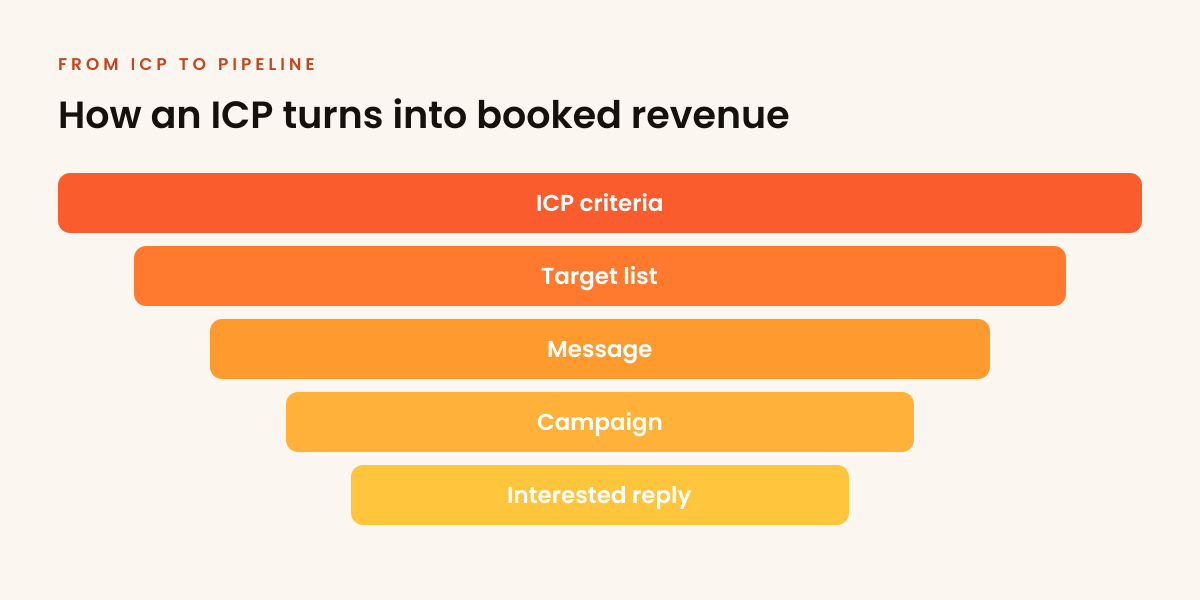
An ICP is only useful once it becomes a list of real companies and real contacts. That is where most definitions quietly die: they live in a slide, never in a campaign.
The rule that holds everywhere in outbound applies here too: a tight, accurate list beats a big one. Two hundred well-matched companies outperform five thousand loosely relevant ones, and they let you write like a human instead of a broadcast.
Add disqualifiers, not just criteria
A working ICP says no more often than it says yes. Alongside the positive criteria, write down the traits that predict a bad fit: too small to have a budget, locked into a competitor on a long contract, in a sector where you have no proof, or in a country you cannot serve. Disqualifiers keep the list honest when someone is tempted to pad it.
In practice, the disqualifier list does more for reply rates than the wish list. Every loosely matched company you remove is one less generic email sent from your domain, which protects both your sender reputation and your time. This is the core of the quality versus quantity trade-off: precision costs you volume and pays you back in conversations.
Tier the list before you write a word
Not every company that passes the ICP filter deserves the same effort. Split the list into two or three tiers:
- Tier 1: perfect fits. Every criterion matches and there is a visible trigger, a new hire, an expansion, a funding round. These get researched, personalised messages, sometimes across email and LinkedIn together.
- Tier 2: solid fits. The criteria match but nothing signals urgency. These get well-segmented campaigns with personalisation at the segment level.
- Tier 3: plausible fits. Worth testing with light-touch messaging, but not worth an hour of research per account.
Tiering is where ICP work meets list segmentation: the profile decides who gets on the list, the tiers decide how much effort each name earns.
Test before you scale
An untested ICP is still an assumption. The cheapest way to check it is a small campaign into one narrow segment. If people reply and the problem lands, the profile is right. If it is silence, or polite interest that never converts, you refine it.
A few hundred well-targeted emails will teach you more about your market than a quarter of internal planning. It is also far cheaper than discovering the mismatch after you have hired an SDR. If no segment replies at all, the question underneath the ICP is whether the offer has product-market fit yet.
Reading the test results honestly
Cold email reply rates in B2B stay in the low single digits as a share of sends, and well-targeted campaigns sit at the top of whatever range your own market produces. If a 200-contact test into one segment produces several interested replies, the ICP is close. If it produces nothing, resist the urge to blame the copy first. In our experience the list is the culprit more often than the message.
Watch what kind of replies come back, not just how many. "Not now, but relevant" confirms the targeting even though it is not a win today. "This is not for us" from several people in the same segment is a targeting signal, not a copy problem. What counts as a good result, and how to judge it, is covered in more depth in what is a good cold email response rate.
Common ICP mistakes and their fixes
- Defining it by who you want, not who buys. Aspiration is not evidence. Fix: build from closed deals and best accounts, then test the stretch segment separately.
- Making it so broad it excludes nobody. "SMEs in Europe" is not a profile. Fix: narrow until you could name fifty specific companies that fit.
- Copying a competitor's positioning. Their ICP reflects their strengths, not yours. Fix: anchor on the problem you demonstrably solve best.
- Never revisiting it. Markets shift, products mature. Fix: review the profile every quarter against the last quarter's closed and lost deals.
- Confusing the ICP with the persona. One picks companies, the other picks people. Fix: define both, in that order.
How this plays out across Europe
In European B2B outbound, geography and language belong in the ICP itself, not as an afterthought. A profile that works in the Baltics, where markets are small and buyers expect directness, often needs adjusting for DACH, where formality, GDPR sensitivity and longer decision cycles change both the list and the message. A German Mittelstand manufacturer and a Lithuanian SaaS firm can share an industry code and still be different ICPs in practice.
The practical rule: one ICP per market-language pair until data proves you can merge them. Writing to a German buyer in English, or applying Nordic informality to a Swiss prospect, wastes an otherwise correct company list.
The most common mistake
Skipping this step because it feels abstract, then blaming the channel when nothing works. Broad targeting forces generic writing, and generic writing gets ignored. Focus is not a limitation here, it is the thing that makes the message land.
Related: TAM analysis and market mapping.
Frequently asked
What is an ideal customer profile?
What is the difference between an ICP and a buyer persona?
How do I know if my ICP is correct?
Rather not build this yourself?
We run the targeting, data, copy and follow-up as a done-for-you service, and send the interested replies straight to your inbox. You bring the close.
Book a strategy call