


Lead quality vs. quantity, and the cost of getting it backwards
The short answer
Sales time is the scarce resource, so quality wins. A qualified lead fits your ICP, has the problem, and can actually buy. High volume without that filter produces busy salespeople, distorted metrics and no additional revenue.
On this page
- Why quality wins on arithmetic
- What a qualified lead has
- Poor leads do active damage
- When volume is genuinely good
- Quality is decided early
- The arithmetic, worked through
- How to grade lead quality without a data team
- Common quality mistakes, with fixes
- If you are thinking "more at the top means more at the bottom"
- What changes when you tighten the filter
- Why this matters more in smaller European markets
"We generated 500 leads this month" sounds like progress. If five of them can buy, it is 495 distractions.

Why quality wins on arithmetic
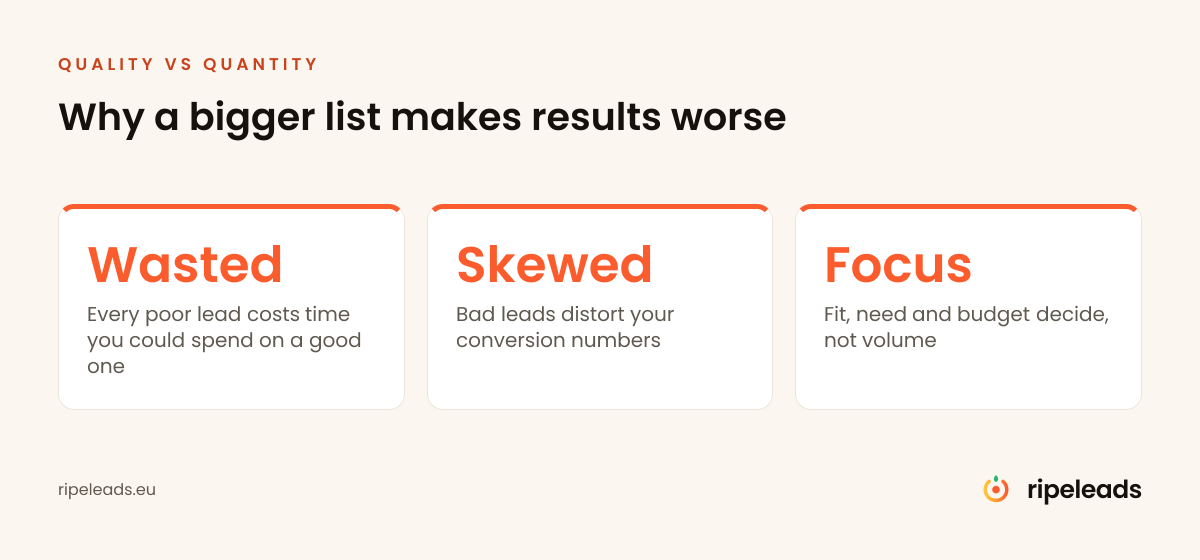
A salesperson has a fixed number of hours. Spend them on people who fit and output rises; spend them on people who do not and it falls. The list length never enters the equation.
What a qualified lead has
Three things, and all three are required:
- Fit with your ICP: sector, size, role.
- A real problem that you actually solve.
- Ability to buy: budget and the authority to spend it.
Poor leads do active damage
They do not merely fail to convert. They consume hours that better prospects deserved, they wear down a team through constant rejection, and they distort the conversion data you use to make decisions.
A high volume of unqualified leads creates the appearance of activity while the pipeline stays empty. Website capture tools invite exactly that failure, which is why a chatbot belongs on high-intent pages only.
When volume is genuinely good
Volume is not the enemy. Volume of well-matched contacts is excellent. The distinction is whether filtering happens before the outreach or never happens at all.
Quality is decided early
It is set when you define the ICP and build the list, not when a salesperson tries to rescue a bad conversation. Filtering late is far more expensive than targeting properly at the start, which is why we treat the list as the most important deliverable.
The arithmetic, worked through
Put numbers on the trade-off. Campaign A contacts 1,000 loosely matched companies. Cold outreach to a loose list replies at the bottom of whatever range your own campaigns produce, so for this example call it 1%: ten conversations, of which perhaps two fit well enough to progress. Campaign B contacts 300 companies filtered hard against the ICP. Tighter lists reply at the top of that same range, say 4% here: twelve conversations, most of which fit by construction, so perhaps seven or eight progress.
Campaign B produced three to four times the qualified pipeline from less than a third of the volume. It also cost less in data, burned less sender reputation, and left 700 companies uncontacted and available for a better-matched campaign later. The volume-first version does not just underperform, it spends the market.
How to grade lead quality without a data team
You do not need a scoring model to start. Three questions, asked before any contact enters a campaign, catch most of the waste:
- Would we honestly want this company as a customer? If the answer needs a paragraph of caveats, it is a no.
- Is there observable evidence of the problem? A hiring pattern, a tech choice, a market they operate in. Evidence, not hope.
- Is the contact person able to start a buying conversation? Right role, right seniority for the deal size.
Once volume grows, formalise the same logic into points, as covered in lead scoring, simplified. And agree with sales what counts as qualified before arguing about it; the vocabulary for that agreement is in MQL and SQL explained.
Common quality mistakes, with fixes
- Measuring leads, not qualified leads. A lead count rewards volume by definition. Fix: report qualified opportunities and meetings held, with lead count as a footnote, which is what good agency reporting puts in front of you.
- Widening the ICP to hit a number. The list grows and the reply rate falls in proportion. Fix: keep the definition fixed for a quarter and change volume by adding segments deliberately.
- Treating every reply as a win. A polite no from a company that could never buy is not pipeline. Fix: track positive replies from in-profile companies only.
- Buying the biggest list available. Price per contact falls as quality falls, which is exactly the wrong incentive. Fix: pay for fit and verification, not for row count.
If you are thinking "more at the top means more at the bottom"
The funnel metaphor suggests volume in equals revenue out, and within one fixed level of quality that holds. Across quality levels it breaks, because conversion is not a constant: it collapses as fit drops. Doubling volume by halving fit routinely produces fewer deals, not the same number, while doubling the workload of whoever handles the replies. Sales capacity is the fixed asset in this equation. Volume is only worth adding when the quality bar stays where it was.
The same logic applies when hiring this out. A vendor quoting spectacular lead volumes at low prices is quoting quantity because quality does not scale that way, which is one of the clearest red flags in agency selection; the questions that expose this are in how to choose an outbound agency.
What changes when you tighten the filter
Expect the dashboard to look worse before it looks better. Lead volume drops, sometimes by half or more, and anyone paid on that number will notice. Then the second-order effects arrive: reply rates climb toward the top of their usual range, meetings hold steady or rise despite the smaller list, no-show rates fall because the people booking have a reason to attend, and sales stops complaining about lead quality because the complaint has nothing to feed on. Give the change a full quarter before judging it, and judge it on revenue per contact, not contacts.
Why this matters more in smaller European markets
In the US a burned list is a rounding error; the market absorbs it. In Lithuania, Latvia or Estonia the total pool of companies matching a given ICP can be a few hundred, and in mid-sized DACH niches a few thousand. Spray a low-quality campaign across that pool and there is no second chance at the same market for a year. Working smaller European markets means treating every in-profile company as scarce, which pushes the whole operation toward quality by necessity. How that looks in practice is covered in outbound in the Baltics.
Frequently asked
Is lead quality or quantity more important?
What makes a lead qualified?
Can you have both quality and volume?
Rather not build this yourself?
We run the targeting, data, copy and follow-up as a done-for-you service, and send the interested replies straight to your inbox. You bring the close.
Book a strategy call