


B2B lead scoring without the complexity: Fit and intent
Lead scoring that fits on one page
The short answer
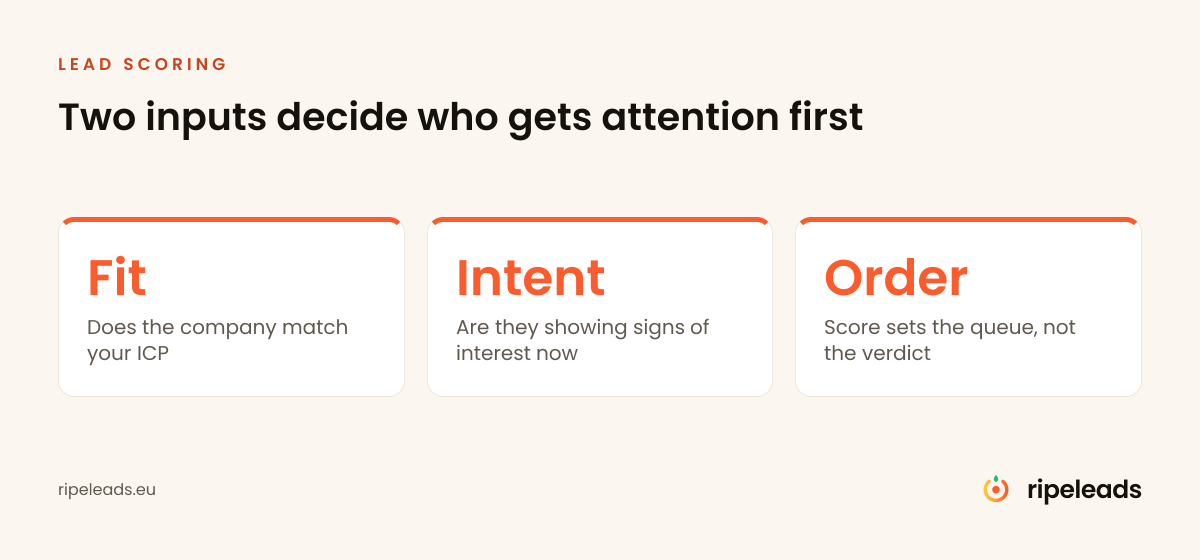
Score on two things: fit (does the company match your ICP) and intent (are they showing interest now). Keep it simple enough to explain in a sentence. Scoring decides the order of work, not whether someone is allowed a conversation.
On this page
- Two inputs, not twenty
- Fit
- Intent
- The four quadrants
- How to build a lead scoring model in an afternoon
- A worked example
- Why complicated models fail
- Scoring sets the queue, not the verdict
- Common lead scoring mistakes
- Where intent actually comes from
- Scoring across European markets
- If you think scoring is not worth the effort
Elaborate scoring models tend to collapse under their own weight. The useful version is much smaller than most people expect.

Two inputs, not twenty
Almost all the value comes from combining fit and intent:
Fit
Does this company match your ICP on industry, size and role? Fit is stable and knowable in advance. It is the half you can score before anyone does anything.
Intent
Are they doing something that suggests the topic is live: replying, asking questions, visiting, hiring in a relevant area. Intent changes constantly, which is why it belongs alongside fit rather than instead of it.
The four quadrants
Combining them gives an obvious priority order:
- High fit, high intent, contact today.
- High fit, low intent, keep nurturing, these become tomorrow's pipeline.
- Low fit, high intent, handle carefully, enthusiasm does not create a good customer.
- Low fit, low intent, leave them.
How to build a lead scoring model in an afternoon
Scoring does not need a data team, and it does not need a marketing automation platform either. Most B2B sales teams can put a workable model in place in a single sitting:
- Write down the three fit criteria that matter most. Usually industry, headcount band and the role you sell to. Anything past three tends to be decoration.
- Give each one a plain yes or no. Resist half points. A company either sits in your segment or it does not.
- Pick four intent signals you can actually observe. A reply, a question, a repeat visit, a relevant job advert. If you cannot see the signal in a tool you already pay for, leave it out.
- Set one threshold. Two or three fit criteria met, plus any intent signal, means the lead goes to the top of today's queue.
- Review the queue weekly for a month. If the top of the list keeps producing conversations that go nowhere, one of your fit criteria is wrong, not the maths. Track it alongside your other sales metrics so the review has numbers behind it.
That is the whole build. The hard part is not the model, it is agreeing on the fit criteria, which is a targeting question rather than a scoring one, and usually a shared sales and marketing definition that both sides sign off on.
A worked example
Take a recruitment agency selling permanent placement into mid-sized manufacturers. Fit is: manufacturing or industrial, 100 to 1000 employees, and a named HR or operations decision maker. Intent is: a vacancy posted in the last 30 days, a reply to a previous sequence, or a leadership change in the past quarter.
A 400-person components manufacturer with six open production roles and a new operations director scores high on both. That one goes to the top of the call list this morning. A 900-person plant that matches the profile perfectly but has posted nothing for six months is high fit, low intent: worth a quarterly touch, not worth today's best hour. A 20-person consultancy that replied enthusiastically to a newsletter is low fit, high intent, and a polite ten-minute answer serves it better than a discovery call.
Nothing in that example needs a weighted algorithm. It needs someone to write three criteria down and stop arguing about them.
Why complicated models fail
A model with twenty weighted signals is impossible to explain, and anything a sales team cannot explain, it does not trust. Untrusted scores get ignored, at which point the model is just maintenance work.
If you cannot describe why someone scored highly in one sentence, simplify it.
Scoring sets the queue, not the verdict
A score is a prioritisation aid, not a gate. Treating a low score as a refusal to engage bakes yesterday's assumptions into today's decisions, and those assumptions are frequently wrong at the edges.
Common lead scoring mistakes
- Scoring on data you do not have. Models that depend on fields nobody fills in decay within weeks. Score on what your CRM reliably holds.
- Counting opens as intent. Open tracking is unreliable and inflated by security scanners. Replies, booking-link clicks and inbound questions carry signal; opens mostly do not.
- Letting the score replace the conversation. A score orders the work. Qualification still happens on the call.
- Never retiring old signals. Intent goes stale. A vacancy from March is not intent in August. Put a decay window on every behavioural signal, roughly 30 to 90 days depending on your sales cycle.
- Adding a field to explain every miss. Each lost deal tempts someone to bolt on a new criterion. Three misses pointing the same way justify a change; one does not.
Where intent actually comes from
Most teams overestimate how much intent they can buy and underestimate how much they already generate. Sequence replies, calendar link clicks, repeat visits to a pricing page and inbound questions are first-party signals, and they usually beat a purchased score. Public signals sit alongside them: hiring activity, funding, leadership moves, new site openings, tender announcements. Both feed the same column. The piece on buying signals and trigger events covers what to watch and how to act on it.
One caution on intent: a signal only counts if you can name the action it triggers. If a funding round changes nothing about what you would say to that company, it is news, not intent.
Scoring across European markets
Scoring gets harder once a list spans several countries. Size bands do not translate cleanly: a 150-person firm is mid-market in Germany and a large employer in Lithuania. Sector codes differ between national registers, so a fit rule written against one classification misfires against another. Available intent varies too, because public hiring data is far richer in some markets than others.
The practical fix is to score within a market rather than across the whole list. Run one queue per country, keep the criteria consistent in meaning rather than in absolute numbers, and let each market's queue compete for attention on reply rate rather than on raw score. Campaigns we run in Lithuanian, Latvian, Estonian, Polish, Czech, Slovak, German, English and Russian are scored this way for exactly that reason.
If you think scoring is not worth the effort
That objection holds when a list is small. Under a hundred accounts, a sensible person reading top to bottom does about as well as a model. Scoring earns its keep once the list outgrows what one person can hold in their head, or once two people work it and their instincts differ.
The other common objection is that scoring buries good leads. It will, if the score becomes a filter. Keep every lead reachable, park the low scores in a nurture track rather than a bin, and revisit when something changes. Not-ready leads become ready on their own schedule, not yours.
Frequently asked
What is lead scoring?
What should a lead score be based on?
Why do lead scoring models fail?
Rather not build this yourself?
We run the targeting, data, copy and follow-up as a done-for-you service, and send the interested replies straight to your inbox. You bring the close.
Book a strategy call