


MQL and SQL explained (and where the line sits)
MQL, SQL, and the handover that decides everything
The short answer
An MQL is a contact marketing considers ready to pass on. An SQL is one sales has checked and accepted as a real opportunity. The definitions matter less than the fact that they are written down and agreed.
Most arguments between marketing and sales are really arguments about an undefined handover. MQL and SQL are two checkpoints inside the wider job of lead qualification.

On this page
- MQL vs SQL at a glance
- The two terms
- What each one means
- Why the line has to be written
- What good criteria look like
- Track the rejections
- In outbound the line is different
- A worked example: from reply to SQL
- What the conversion numbers tell you
- The handover agreement, written in an hour
- What travels with a qualified lead
- Common MQL and SQL mistakes
- When marketing and sales are the same two people
MQL vs SQL at a glance
An MQL and an SQL are two checkpoints, each with its own owner and evidence. Outbound has no inbound signal, so the checkpoint moves to the reply.
| MQL | SQL | |
|---|---|---|
| Full name | Marketing qualified lead | Sales qualified lead |
| Who decides | Marketing | Sales, after checking the lead |
| Evidence | Fits the ICP and has taken a specific action or stated a specific need | Budget, authority, need and timing confirmed on a call |
| What happens next | Sales contacts it within the agreed window | It enters the pipeline as an opportunity |
| In outbound | A reply that fits the ICP and names a problem | A replying contact who can start a buying conversation |
| If it fails | Rejected with a reason: wrong fit, no need, no authority or bad data | Returned to nurture or closed with a reason |
Where marketing hands over to sales is the line between demand generation vs lead generation. The qualification frameworks sit in what lead qualification is, and the stage after the handover in B2B funnel stages.
The two terms
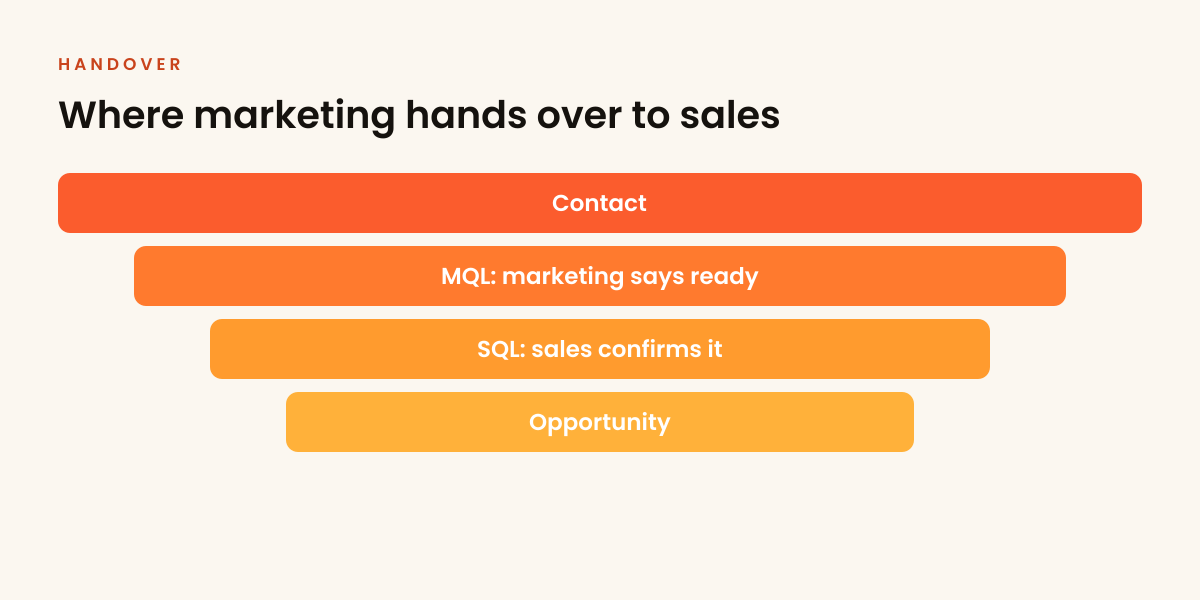
Plainly:
What each one means
MQL: marketing believes this contact is interested enough to be worth a salesperson's time, which is where demand generation hands over to lead generation.
SQL: sales has looked at it and agrees there is a real opportunity here.
Why the line has to be written
Without a written rule, every person applies their own standard on any given day. Marketing counts leads that sales considers worthless, sales rejects leads marketing considers good, and both conclude the other is not doing their job, which is the most common failure point in sales and marketing alignment.
The fix is unglamorous: agree the criteria, write them down, and revisit them when the data says they are wrong.
What good criteria look like
Concrete and checkable, not sentiments:
- Matches the ICP on industry, size and role.
- Has shown a specific action or expressed a specific need.
- Has some indication of budget and authority.
Track the rejections
The most useful number is how many MQLs sales rejects and why. That single figure tells you whether your targeting or your criteria need adjusting, and it turns a recurring argument into a data question.
In outbound the line is different
In outbound there is no inbound signal to interpret, so the equivalent question is whether a replying contact is a real opportunity or just polite. The principle holds: write down what qualifies, so it is decided consistently.
A worked example: from reply to SQL
Take an outbound campaign for a staffing firm. An operations director at a manufacturing company replies: "Interesting, we do struggle to fill welder roles. Send me some information." Is that an MQL, an SQL, or noise?
With written criteria, the question answers itself. Fits the ICP: yes, right sector, right size, right role. Expressed a specific need: yes, named the exact problem. Budget and authority: unknown. So the contact enters as an MQL, and a salesperson's first call has one job: establish whether this person can start a buying conversation. If yes, it graduates to a sales-qualified lead and enters the pipeline as an opportunity. If the director turns out to be gathering brochures with no mandate, the contact moves to a nurture track rather than clogging the forecast. Without the criteria, that same reply gets counted as pipeline by one person and discarded by another.
What the conversion numbers tell you
Two ratios carry most of the signal. MQL-to-SQL acceptance in healthy B2B teams commonly lands somewhere between a third and a half; the exact figure matters less than its trend. If sales accepts nearly everything, the MQL bar is set too high and marketing is under-delivering volume it could safely pass on. If sales rejects well over half, the bar is too low or the targeting is off, and salespeople are doing marketing's filtering for them.
The second ratio is SQL-to-closed-deal. If accepted leads convert poorly, the qualification step is rubber-stamping rather than checking. Read the two together each quarter and the handover largely tunes itself.
The handover agreement, written in an hour
Larger companies call this a service-level agreement. A small team needs one page:
- MQL definition: the concrete criteria a contact must meet, three to five lines.
- Required fields: what information travels with the handover, so sales never opens an empty record.
- Response time: sales contacts every accepted MQL within an agreed window, typically 24 to 48 hours, because interest decays fast.
- Rejection reasons: a fixed short list (wrong fit, no need, no authority, bad data), so rejections become analysable instead of anecdotal.
- Review date: one meeting per quarter where the criteria are adjusted against actual close rates.
What travels with a qualified lead
The agreement fails quietly when the record arriving in the CRM is thin. A salesperson opens a contact holding a name, a company and a box ticked "qualified", and the first call starts from nothing. That is a data problem wearing the costume of a definitions problem, and it throws away the qualification work already done.
Five fields carry most of the value:
- Source and date: which campaign or channel produced the contact, and when.
- The trigger: the exact reply or action that met the criteria, quoted rather than paraphrased.
- Fit evidence: which ICP conditions the company matches, so nobody researches the account twice.
- Known gaps: what has not been established yet, usually budget and authority, which gives the first call a clear objective.
- Owner: the named person responsible from this moment, with no shared queue sitting in between.
Teams that keep those five fields consistent get through the quarterly review in an hour, because every rejection can be read against the evidence that produced it. Teams that do not argue from memory instead. The wider discipline behind this sits in CRM hygiene.
Common MQL and SQL mistakes
- Counting MQLs as pipeline. An MQL is a hypothesis, not revenue. Fix: forecast from SQLs onward only.
- Scoring on activity instead of fit. Opening five emails signals curiosity, not budget. Fix: weight who the contact is above what they clicked, and formalise it as in lead scoring, simplified.
- Letting rejected MQLs vanish. A contact that is wrong today is often right in two quarters. Fix: route rejections with a reason of "not now" into a follow-up rhythm, as covered in nurturing not-ready leads.
- Slow handovers. An MQL contacted a week later has forgotten the interaction that qualified it. Fix: enforce the response-time line of the agreement.
- Debating definitions in the abstract. Fix: review ten real recent leads together and set the line where the disagreements were.
When marketing and sales are the same two people
Most European SMEs run this handover inside one small team, sometimes inside one head. The vocabulary still earns its keep, because the failure mode does not need two departments: it needs only one busy person treating every polite reply as an opportunity and every quiet week as a targeting problem. Writing down what qualifies keeps a two-person operation honest in exactly the way it keeps a two-department one honest. In outbound-led teams the practical line sits at the reply: what to do with a positive answer before it is qualified is covered in when a prospect says yes.
Our companion piece, ASIC, ABN and ABR: Australian business data explained, covers this from a different angle.
Frequently asked
What is the difference between an MQL and an SQL?
Why do MQL and SQL definitions cause arguments?
What should qualification criteria include?
What is lead scoring?
What should a lead score be based on?
What does MQL stand for?
Who decides whether a lead is an MQL or an SQL?
Is a reply to a cold email an MQL?
Rather not build this yourself?
We run the targeting, data, copy and follow-up as a done-for-you service, and send the interested replies straight to your inbox. You bring the close.
Book a strategy call Or get a free target list first