


How to build a multichannel outreach sequence (LinkedIn + email)
The short answer
Build a multichannel sequence as six touches over about three and a half weeks, alternating LinkedIn and email. LinkedIn carries recognition and email carries the offer. Never send two messages on the same day, widen the gaps as the sequence runs, stop every channel the moment a reply lands anywhere and keep both channels in the prospect's language. Track positive replies per hundred prospects entered, not per channel.
The same person who ignores your email will often reply to a message from someone whose name they have already seen.

On this page
- Why one channel is weaker alone
- Why the combination works
- Order and pacing
- A three-week multichannel sequence, step by step
- The six-touch multichannel sequence
- What each channel should carry
- The mistake that ruins it
- What it demands operationally
- Four more ways multichannel sequences fail
- What to measure when two channels run together
- Running multichannel across European markets
- If you think this is too much work
- Frequently asked
Why one channel is weaker alone
Each has a real limitation. LinkedIn is warmer but low volume. Email scales but arrives without context. Used separately, each fights its own weakness; used together, they cover for each other.
Why the combination works
Seeing you in two places changes how the outreach reads. One email can be dismissed as random. An email plus a LinkedIn message from the same person looks deliberate.
That shift, from noise to intent, is where the improvement in reply rate comes from.
Order and pacing
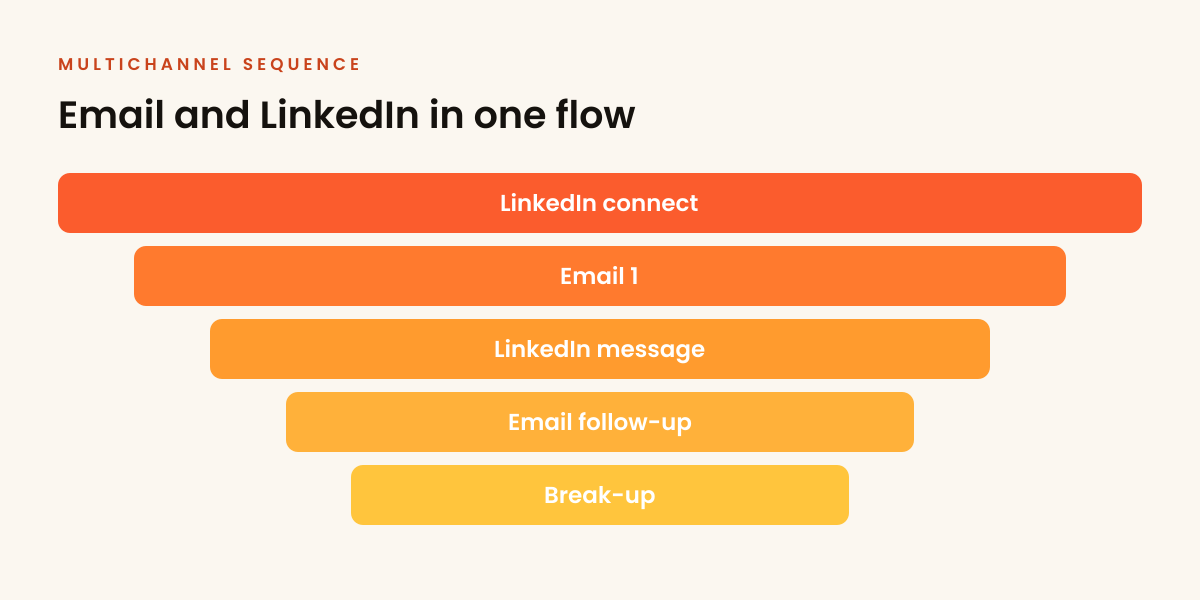
A common structure opens with a connection request to establish familiarity, moves to email for the actual offer, then returns to LinkedIn as a reminder before continuing the email follow-up.
The exact order matters less than the pacing.
A three-week multichannel sequence, step by step
Here is a shape that holds up for most B2B offers. Treat the day numbers as spacing rather than law, and shift them around public holidays and local hiring seasons.
- Day 1, LinkedIn: view the profile, then send a connection request with no pitch in it. One line naming why you are connecting is enough.
- Day 3, email one: the substantive message. One observation about their business, one offer, one small ask. This email carries the actual proposition.
- Day 6, LinkedIn: if the request was accepted, send a short message that refers to the email without repeating it. Two sentences.
- Day 10, email two: a different angle on the same problem. Not "just bumping this", but new information: a comparable situation, a number, a question they can answer in one word.
- Day 17, email three: the short close. Ask whether the timing is wrong rather than whether they are interested.
- Day 24, either channel: the break-up message. Say you will stop, leave the door open, and then actually stop.
Six touches across three and a half weeks. Nobody receives two messages on the same day, and the gaps widen as the sequence runs. The warm-up half of a multichannel sequence is in B2B social selling.
The six-touch multichannel sequence
Treat the day numbers as spacing, not law, and shift them around public holidays and local hiring seasons. The list behind it matters first: see how to find decision makers on LinkedIn.
| Touch | Day | Channel | Job of the touch |
|---|---|---|---|
| 1 | 1 | View the profile, then send a connection request with one line on why you are connecting and no pitch | |
| 2 | 3 | The substantive message: one observation about their business, one offer, one small ask | |
| 3 | 6 | If the request was accepted, two sentences that refer to the email without repeating it | |
| 4 | 10 | A different angle on the same problem: a comparable situation, a number or a one-word question | |
| 5 | 17 | The short close: ask whether the timing is wrong rather than whether they are interested | |
| 6 | 24 | Either | The break-up message: say you will stop, leave the door open and then stop |
Nobody receives two messages on the same day, and the gaps widen as the sequence runs.
What each channel should carry
The two channels are not interchangeable, so do not push the same text through both. Split the job:
- LinkedIn carries recognition. A face, a shared connection, a company page. It buys you the half-second of "I know that name" when your email arrives.
- Email carries the offer. It is the only channel where a prospect can forward you to a colleague, and forwarding is how most deals actually move inside a company.
- Neither carries the deck. Attachments and long pitches belong on the call, not in a first touch on either channel.
If you are still deciding how to weight the two, the trade-offs are set out in cold email vs. LinkedIn outreach.
The mistake that ruins it
Multichannel does not mean contacting someone everywhere at once. Several messages across channels in a single day reads as pressure, not persistence. Touches belong spread across weeks, so you stay visible without becoming a nuisance.
What it demands operationally
Two channels means tracking who is at which step, so nobody gets the same message twice or drops out silently. Without that discipline it becomes chaos rather than a sequence, which is the main reason teams abandon multichannel after a few weeks.
Four more ways multichannel sequences fail
- Copying the email into LinkedIn. The prospect reads the same paragraph twice and concludes you are running software, not thinking about them. Fix: rewrite the LinkedIn touch to half the length and drop the offer from it entirely.
- Automating connection requests hard. Volume limits on LinkedIn are real and account restrictions are permanent enough to hurt. Fix: keep daily requests modest and manual-looking, and read where the line sits on automation before scaling.
- Letting a reply on one channel continue on the other. Someone answers on LinkedIn, and the email sequence keeps firing. Fix: one shared stop rule, applied the moment any reply lands anywhere.
- Sequencing people who were never a fit. Two channels multiply a bad list rather than rescuing it. Fix: tighten the ICP definition before adding a second channel, not after.
What to measure when two channels run together
Attribution gets muddy fast, because a prospect who saw your profile on Monday and replied to an email on Thursday will be logged as an email reply. Measure the sequence, not the channel, and build an outbound reporting dashboard around that unit.
Hold any borrowed benchmark loosely and build your own instead. Cold email replies come from a small share of a decent list. LinkedIn connection acceptance on a well-targeted list runs much higher than an email reply rate, though the message reply rate behind it is smaller than the acceptance number suggests. A combined sequence generally lifts total replies rather than doubling them. Track positive replies per hundred prospects entered, and compare that against your single-channel baseline over the same period. More context on realistic figures sits in outbound benchmarks.
Running multichannel across European markets
Language choice decides whether the second channel helps or hurts. A German prospect who receives a German email and then an English LinkedIn message notices the seam immediately, and the sequence starts to read as outsourced. Keep both touches in the same language, including the connection note.
Timing shifts too. In DACH, August and the fortnight around Christmas are close to dead for outbound, so a sequence launched in late July finishes into silence. In the Baltics and Poland, decision makers are reachable for more of the summer but respond better to direct, unadorned wording. GDPR does not block business-to-business outreach on either channel, though it does require a lawful basis, a clear identity and a working opt-out on the email side, with tighter constraints again under German cold email law. We run campaigns in Lithuanian, Latvian, Estonian, Polish, Czech, Slovak, German, English and Russian, and the pattern holds across all four: same language, same tone, same sequence, two channels.
If you think this is too much work
It is more work than sending email alone, and that is the honest answer. Six touches across two channels for a list of five hundred prospects is a real operational load, and it needs a tool that shows one timeline per person rather than two separate campaign reports.
The alternative is not free either. Single-channel email at the same volume burns through the same list with a lower ceiling, and adding more sending domains to compensate costs money and attention. If the sequence is going to run for a quarter or longer, the multichannel version usually returns more meetings per prospect contacted, which is the number that matters when a list is finite.
If you would rather hand the LinkedIn half to a provider than run it yourself, the LinkedIn lead generation agencies page compares four that run it alongside email. When a named list of accounts beats volume, the account-based marketing page explains the three ABM tiers.
Frequently asked
How do I build a multichannel outreach sequence with LinkedIn and email?
What is a multichannel outreach sequence?
In what order should I use LinkedIn and email?
What should LinkedIn and email each carry in a sequence?
How quickly should multichannel touches follow each other?
What is a sales cadence?
How many touches should a cadence have?
Rather not build this yourself?
We run the targeting, data, copy and follow-up as a done-for-you service, and send the interested replies straight to your inbox. You bring the close.
Book a strategy call Or get a free target list first