


B2B social selling: what it is, examples and where to start
Social selling, minus the buzzword
The short answer
B2B social selling means building familiarity before the pitch. The test that separates it from spam: if the message could be sent unchanged to anyone, it is not social selling. It is slow, it compounds, and it works best alongside direct outreach rather than instead of it.
Behind the buzzword is something simple: be a known quantity before you ask for someone's time.

On this page
- Social selling vs spam
- The definition, and the honest test
- Why it works in B2B
- A realistic starting point
- What to post when you think you have nothing to say
- An hour a week, spent properly
- The commenting half that most people skip
- Consistency beats intensity
- It pairs with outreach, it does not replace it
- Set the right expectation
- Where automation crosses the line
- Common social selling mistakes
- Measuring something other than likes
- How this plays out across European markets
Social selling vs spam: the test applied
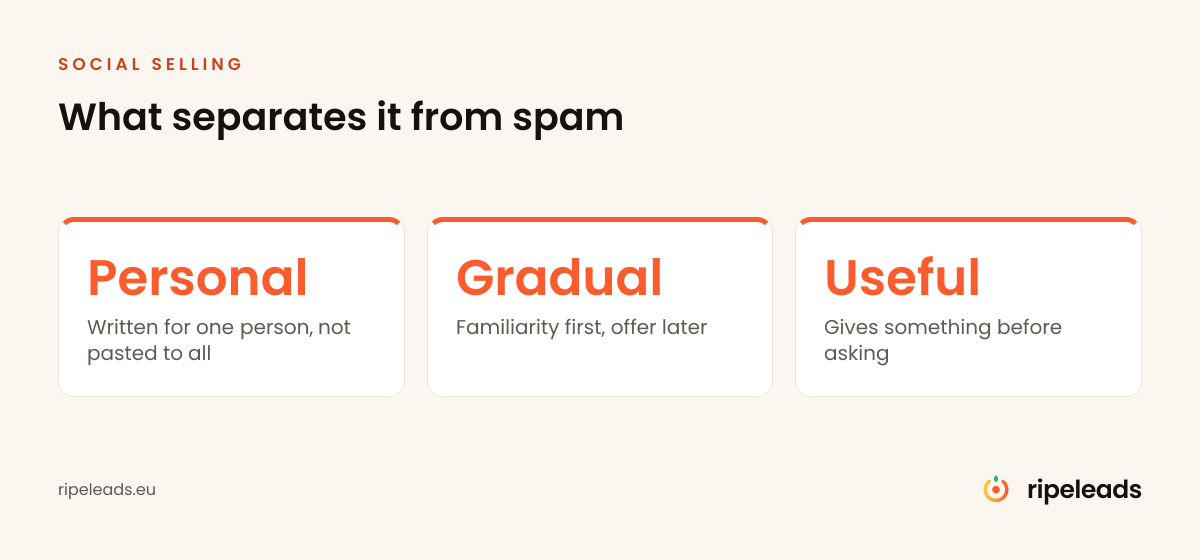
The test is simple: if the message could be sent unchanged to anyone, it is not social selling. The table applies it.
| Behaviour | Social selling | Spam |
|---|---|---|
| The message | Specific to the person and their work | Could go to anyone unchanged |
| Before the ask | You are a known quantity: posts, comments, a real profile | A cold pitch from a profile stuffed with offers |
| Connection request | A short, specific reason to connect | A pitch in the connection note |
| What you post | Questions customers ask, what went wrong and what changed, a number from your operation, a pattern across accounts | Generic advice and promotions |
| Pace | An hour a week, kept up for two quarters | A burst of automation, then silence |
Social selling pairs with direct outreach rather than replacing it. See LinkedIn outreach for B2B: process, limits, messages for the outreach side and how to find decision makers on LinkedIn for who to talk to.
The definition, and the honest test
Social selling is building a relationship through a platform, usually LinkedIn, before making a direct offer. It covers useful posts, real participation in conversations, and personal outreach, and it sits inside the wider question of social media as a B2B lead source.
One test separates it from spam cleanly: if the message could go to a hundred people unchanged, it is spam wearing a nicer word.
Why it works in B2B
B2B decisions are slow and carry personal risk for the buyer. People buy from those they recognise and trust. Weeks of visible, useful presence means your eventual offer lands on prepared ground rather than in an empty field, which is also why borrowed credibility works, as B2B influencer marketing shows.
A realistic starting point
You do not need an audience or viral posts:
- A clear ICP, so you know who you are talking to.
- A few specific, useful posts a week.
- Polite, personal outreach to the right people.
What to post when you think you have nothing to say
The blank page stops more social selling programmes than any algorithm does. Almost everything worth posting comes out of work you already do:
- A question a customer asked this week, and the answer you gave.
- Something that went wrong and what changed because of it. Specific failures read as credible, general advice does not.
- A number from your own operation, honestly framed. Ranges are fine, invented precision is not.
- A pattern across several accounts, anonymised. Buyers recognise themselves in patterns.
- A disagreement with received wisdom in your field, argued rather than announced.
Five sources, two posts a week, and the year is covered. None of it requires an original thought before breakfast.
An hour a week, spent properly
- Fifteen minutes writing. Two short posts drafted in one sitting and spread across the week.
- Twenty minutes commenting. Ten considered replies on posts by people in your target segment, not by your peers.
- Fifteen minutes on the list. Review who engaged with what and add the relevant names to the outreach queue.
- Ten minutes of direct messages. Personal, short, referencing something real. Five a week beats fifty.
That routine survives a busy quarter. A programme demanding three hours a week does not, and an abandoned programme is worse than none at all.
The commenting half that most people skip
Posting is the visible part; commenting is where familiarity is actually built. A useful comment on a prospect's post puts your name in front of them and in front of their network, at no cost and with no pitch attached. Ten good comments a week reach more of the right people than one post that happens to do well.
Useful means adding something: a counter-example, a specific number, a question that moves the thread on. "Great post" is worse than silence, because it marks you as someone with nothing to say. Sales Navigator makes it practical to watch a defined list of accounts instead of whatever the feed decides to show.
Consistency beats intensity
Two useful posts every week for six months beats twenty posts in one week followed by silence. The compounding only happens if you are still there in month four.
It pairs with outreach, it does not replace it
Social selling on its own grows slowly. Direct outreach on its own arrives cold. Together, content warms the audience while direct messages start specific conversations. Most teams that give up on social selling were relying on it alone.
Set the right expectation
This is a months-long channel. Anyone expecting deals within a week will conclude it does not work. Anyone measuring over quarters usually finds it becomes their warmest source of conversations.
Where automation crosses the line
Tools that scrape, auto-connect and auto-message at volume defeat the one thing that makes social selling work, and they carry account risk on top. Scheduling your own posts is fine. Building a target list is fine. Generating personalised-looking messages at scale is where it turns back into spam with better formatting, and where automation risk stops being theoretical.
The honest test from earlier applies to the tooling as much as to the copy: if a tool can send the message unchanged to a hundred people, sooner or later it will.
Common social selling mistakes
- Pitching inside the connection request. The request buys attention, not a hearing. Make the ask later.
- Writing for peers instead of buyers. Posts that impress other salespeople rarely reach the operations director who signs.
- Posting only company news. A feed of product announcements is advertising, and readers treat it as such.
- Talking to the wrong seniority. Familiarity with a user does not move a deal if the budget sits two levels up, so build the target list around the people who decide.
- Disappearing after a strong month. The compounding resets, and restarting costs more than continuing would have.
Measuring something other than likes
Three numbers show whether this is working. Profile views from your target segment, because that proves the right people are looking. Conversations started by the other side, because that is the return the channel exists for. And reply rate on your direct outreach compared with the period before you started posting, because a warmed audience should lift it. An hour a week is still a real cost, so judge the channel on cost per meeting the way you would when weighing outbound against paid ads.
Give it two quarters before judging. Engagement moves in weeks, pipeline moves in months, and a channel judged on the first number gets shut down before it produces the second.
How this plays out across European markets
LinkedIn's usefulness varies noticeably by market. In DACH the platform is well populated but the register is more formal, and a post written in the loose American style reads as unserious to a German buyer. In the Baltics the networks are smaller and more interconnected, so a single good post travels further and a clumsy one is remembered longer. Posting in the buyer's language rather than defaulting to English changes reach in both cases.
Ripe Leads runs campaigns in the buyer's own language for that reason: the platform is identical everywhere, the manners are not.
See Selling into Australia from Europe for the fuller picture.
Frequently asked
What is social selling?
How is social selling different from spam?
How long does social selling take to work?
What are some B2B social selling tips to get started?
Which social media platform is best for B2B lead generation?
Does social media actually generate B2B leads?
What are examples of B2B social selling?
Is social selling worth it for B2B?
Rather not build this yourself?
We run the targeting, data, copy and follow-up as a done-for-you service, and send the interested replies straight to your inbox. You bring the close.
Book a strategy call Or get a free target list first