


The cold email sequence that gets replies
The short answer
A cold email sequence is five emails over about four weeks, each adding a new angle. Send them on days 1, 4, 9, 16 and 25 to 30, widen the gaps as you go, reply in the same thread and stop the moment someone objects. The opener alone collects well under half of a sequence's replies, so stopping after one email leaves most of the result unclaimed. Full text of all five emails is below.
Most people send one email, hear nothing, and conclude the prospect is not interested. Usually the prospect was just busy.

On this page
- Silence is rarely a no
- How many, and how far apart
- Every message adds something
- The break-up message
- Know when to stop
- Automated or written by hand
- A five-touch follow-up sequence, written out
- What follow-up emails contribute in numbers
- Cold email sequence template: all five emails written out
- What to track per touch
- Follow-up mistakes that kill replies
- If you are thinking "this will annoy people"
- Mixing in other channels
- Frequently asked
Silence is rarely a no
The first email arrives at a random moment in someone's day. It gets buried, or read at a bad time, or noted and forgotten. None of that means no.
A sequence exists to catch the moment the first message missed, since only a small share of any list is actively in a buying cycle in a given month. This is the cheapest improvement available in outbound, because it extracts more from contacts you already have.
How many, and how far apart
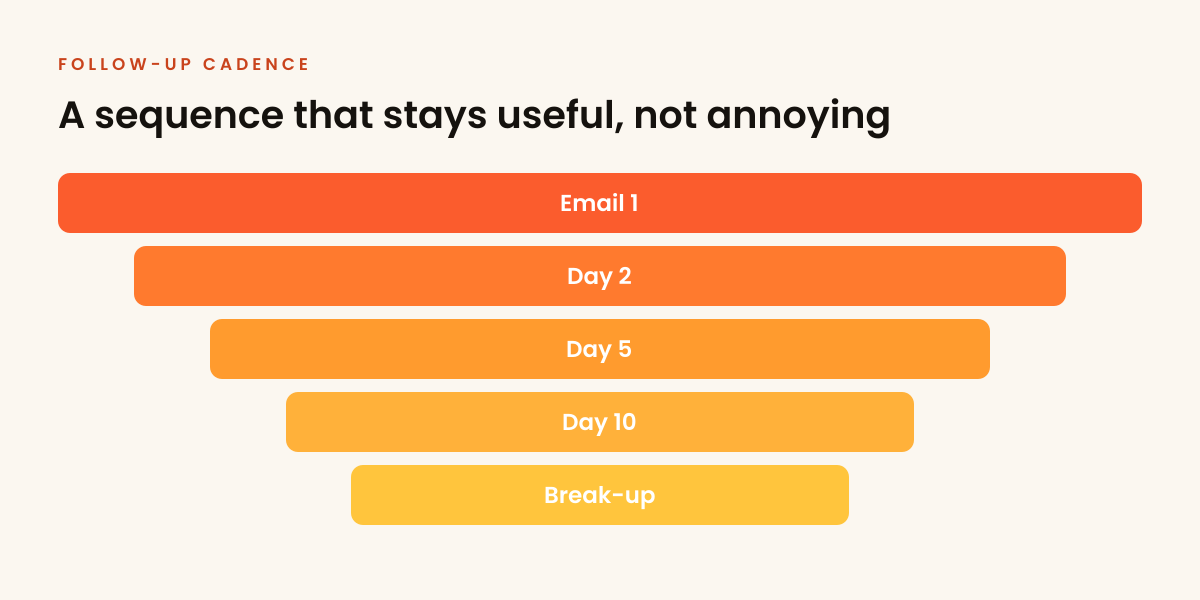
Three to five touches over a few weeks works well. The spacing should widen as it goes, not tighten:
Every message adds something
"Just following up" gives the reader nothing and quietly asks them to feel guilty. Each touch should carry a new angle: a different aspect of the problem, a relevant example, or a question that is easy to answer in one line.
A sequence is a conversation that unfolds, not the same request repeated louder.
The break-up message
The last email closes the loop politely and says you will stop. It reliably produces replies, because people respond to a door closing. Done without guilt-tripping, it often surfaces a genuine "actually, this is relevant, just not this month."
Know when to stop
A sequence needs an ending. Stop when the planned touches are done, and stop immediately if someone asks not to be contacted. That request is honoured at once and the contact comes off the list.
Silence is not permission to continue forever. Contact hygiene is part of doing this professionally, and in Europe it is also a legal obligation.
The planned endpoint is a ceiling, not a target. Several signals justify stopping earlier: an explicit no, whether or not the person used the word unsubscribe; a hard bounce, since the address is dead and continuing to send at it damages the domain; an auto-reply saying the person has left, in which case use the named replacement if one is given; a wrong-fit reply telling you they do not do the thing you assumed, which means fixing the list rather than continuing the sequence; a forward to someone else, where the original contact's sequence ends there; and any hint of irritation, since the cost of one more email is a complaint and the upside is close to zero.
Keep a do-not-contact record: a list every future campaign checks before it sends, so a contact who opted out once does not get picked up again by a different list or a different client. That is the practical mechanism behind the legal obligation, not a separate courtesy.
Automated or written by hand
Both. Automate the baseline so nothing is forgotten, and write by hand where it matters. Fully automated sequences read as mechanical, fully manual ones do not survive any real volume.
A five-touch follow-up sequence, written out
Here is a cadence we use as a starting point for B2B campaigns. Adjust the gaps to your market, but keep the shape: widening intervals, new angle every time.
- Day 1, the opener. The core message: one observed problem, one sentence on how you solve it, one small ask.
- Day 4, the nudge. Reply in the same thread. One or two lines adding a concrete detail the opener left out, such as who this worked for or what changed.
- Day 9, the new angle. Approach the same problem from a different side: a cost the prospect may not have counted, or a question about how they handle it today.
- Day 16, the low-effort ask. Shrink the request. Instead of a meeting, ask a question they can answer in one line, or offer to send something useful with no call attached.
- Day 25-30, the break-up. Close the loop, say you will stop, leave the door open. The mechanics are covered in the break-up email.
Five touches is a ceiling for one sequence, not a licence for perpetual contact. Where the line sits after that is covered above.
What follow-up emails contribute in numbers
Across most B2B cold email campaigns, the opener alone collects well under half of the total replies the sequence will produce. Each later touch adds a smaller share than the one before, which is exactly why the sequence works: the touches are cheap, the contacts are already paid for, and every message is another chance to land at the right moment. A campaign that stops at one email leaves a large share of its replies unclaimed, and you can see exactly how large by tagging each touch in your own sending tool.
Expect diminishing returns to set in quickly after touch four or five. If a list has produced nothing across a full sequence, the problem is the list or the offer, and a sixth email will not repair either.
Cold email sequence template: all five emails written out
The example sells staffing to an employer with a vacancy open now. Swap the role, the place and the offer for your own, and keep the shape: one new piece of information or one easier ask in every message. Emails 2 to 5 go in the same thread as email 1, so the history travels with them.
| Day | Job of the email | Ask | |
|---|---|---|---|
| 1. Opener | 1 | Name the signal and the offer in two sentences | Send two profiles? |
| 2. Nudge | 4 | Add one concrete detail the opener left out | Same question, restated |
| 3. New angle | 9 | Approach the problem from a different side | One question about how they handle it today |
| 4. Low-effort ask | 16 | Shrink the request, no call attached | Reply with one word |
| 5. Break-up | 25 to 30 | Close the loop and say you will stop | None |
Email 1, day 1: the opener
Email 2, day 4: the nudge
Email 3, day 9: the new angle
Email 4, day 16: the low-effort ask
Email 5, day 25 to 30: the break-up
The wording of each email changes with the market and the offer. The cadence does not. More finished emails, annotated line by line, are in B2B cold email examples.
What to track per touch
Reply rates differ by list, offer and market, so this page prints no benchmark of its own. Tag every touch in your sending tool and fill in the table from your own campaign after the first full sequence.
| Touch | Day | Metric to tag | What it tells you |
|---|---|---|---|
| Email 1 | 1 | Replies per 100 contacts | Whether the list and the signal fit the offer |
| Email 2 | 4 | Replies per 100 contacts still active | How much of the opener's silence was timing |
| Email 3 | 9 | Replies per 100 contacts still active | Whether the second angle opens a different group |
| Email 4 | 16 | Replies per 100 contacts still active | Whether a smaller ask beats a meeting ask |
| Email 5 | 25 to 30 | Replies per 100 contacts still active, plus opt-outs | Whether the break-up earns its place and how irritated the list is |
If emails 4 and 5 add nothing across two campaigns, the problem is the list or the offer. A sixth email will not repair either. Our cold email response rate benchmarks give outside figures to compare against.
Follow-up mistakes that kill replies
- "Just bumping this." The most common follow-up in existence and the weakest. Fix: every touch carries one new piece of information or one easier ask.
- Starting a new thread every time. The reader loses the context and your earlier message. Fix: reply within the thread so the history travels with you. Keep the original subject line; a good one is covered in subject lines that get opened.
- Tightening the cadence when nervous. Three messages in five days reads as pressure. Fix: gaps widen as the sequence progresses.
- Guilt as a tactic. "I guess this isn't a priority for you" produces resentment, not meetings. Fix: stay neutral and useful to the last message.
- Ignoring soft replies. "Not now" or "ask me in Q4" is a result, not a rejection. Fix: park the contact with a dated reminder and honour the date.
If you are thinking "this will annoy people"
Some prospects will be irritated by a fourth email. Far more never registered the first three. A respectful sequence, spaced out and easy to opt out of, sits well within professional norms in B2B, though the legal position varies by country and Germany sets the strictest bar in Europe, and in the campaigns we run recipients mostly treat later touches as a legitimate second chance rather than spam. The annoyance risk lives in the copy and the cadence, not in the act of following up. Write like a person, widen the gaps, stop when asked, and the complaint rate stays near zero.
Mixing in other channels
A follow-up sequence does not have to stay in one inbox. A LinkedIn profile view or connection request between emails two and three makes the name familiar before the next message lands, and a short call attempt late in the sequence catches people who never answer email at all. In the DACH market in particular, where inboxes are conservative and formal, a polite phone touch often outperforms a fourth email. How to combine the channels without doubling the workload is covered in email and LinkedIn in one sequence.
A follow-up that wins a meeting needs a link at the right moment, and the booking link page covers when to send it and what to put around it. Recruitment agencies sending these sequences can follow the 30-day plan on the recruitment agency clients page, which is built on live vacancies. Good-fit leads who are not ready now still matter, and the nurturing page sets out a 12-month cadence for them.
Frequently asked
What is a cold email sequence?
How many follow-ups should a cold email sequence have?
What should each email in a cold email sequence say?
How long should I wait between follow-ups?
When should I stop following up?
Why do leads go cold after only one or two touches?
What is a break-up email?
How do you write a break-up email?
What is the best message to send a prospect who has gone quiet?
Why do prospects go silent after a good meeting?
Rather not build this yourself?
We run the targeting, data, copy and follow-up as a done-for-you service, and send the interested replies straight to your inbox. You bring the close.
Book a strategy call Or get a free target list first