


B2B cold email examples, annotated line by line
In short
A good B2B cold email is three to five sentences: one true, specific observation about the recipient, one sentence on how you help, and one easy question. The seven examples below show that shape in different situations, with the choice behind each line marked, so you can write your own instead of pasting someone else's. This page is for sales outreach, not job or internship applications.
On this page
- What a good B2B cold email has in common
- Example 1: a German email built on real vacancy data
- Example 2: the hiring-signal email
- Example 3: the new-market email
- Example 4: the path-in email
- Example 5: the follow-up bump
- Example 6: the break-up
- Example 7: a bad email, rewritten
- What these examples do not show: the reply rate
- How to adapt an example without sounding like a template
What a good B2B cold email has in common
Every example on this page has four parts and nothing else: a reason for writing now, a reason it matters to this reader, one sentence on what you do, and one low-effort question. Examples 2 to 7 are constructed for this page with generic company names, and each is labelled. Example 1 is the sample email we show on our homepage. None of them carries a reply rate, and none is a client email.
The mechanics behind the four parts are in how to write a cold email that gets replies. Here the work is reading finished emails and seeing why each line is there. The table lists all seven first.
| Example | Situation | Reason for writing now | Ask |
|---|---|---|---|
| 1. German sample | Company with an open driver vacancy | The ad has been live for nearly two weeks | A 20-minute call |
| 2. Hiring signal | Company hiring for a role you help fill | The ad has been open for several weeks | Permission to send two profiles |
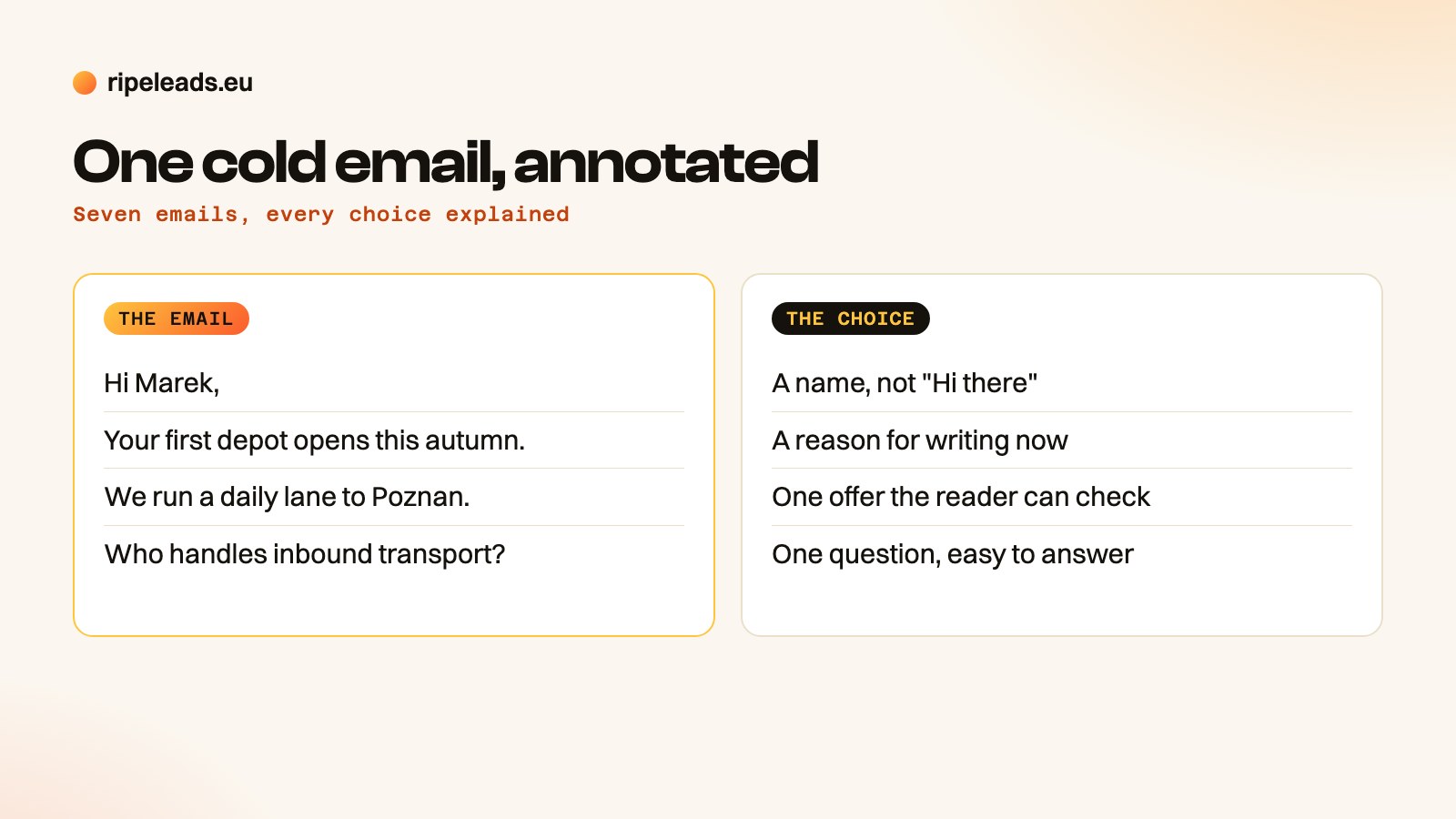
| 3. New market | Company opening in a new country | The first depot opens this autumn | Who handles inbound transport |
| 4. Path in | A shared, checkable interest | A talk the reader gave | A short exchange by email |
| 5. Follow-up bump | No reply after three or four days | A new fact you left out | The same question, restated |
| 6. Break-up | No reply after two to three weeks | You are closing the thread | One word in reply |
| 7. Bad email | Generic opener and feature list | None | A 30-minute demo |
Example 1: a German email built on real vacancy data
This is the sample email from the "Inside a campaign" section of our homepage, where it is tagged Sample. The vacancy data behind it is real: the Bundesagentur für Arbeit job board, scraped on 22 July 2026. The email itself is an illustration of what goes out, not a message a client sent.
English translation:
Why each line is there. The first sentence is the reason for writing: a published job ad, which the recipient knows is public and still open. "Exactly the roles we fill" states the offer in one clause. The second paragraph answers the buyer's first doubt, whether a driver can start quickly, with the steps we handle. The ask is 20 minutes, a small commitment with a concrete payoff, the number of available drivers. The sign-off is a first name, as in a message between two people. The language is German because the reader works in German, which multilingual outbound covers in full.
Example 2: the hiring-signal email
Constructed example, not a client email. The company and people are generic. The signal is the open vacancy, the same trigger as Example 1 in a different industry.
The choices. The ad is the reason for writing, named by role and city so it cannot be mistaken for a mass send. The offer sits in one sentence and says who you place, with the two skills that matter for this role. The ask costs the reader nothing: permission to send two profiles. Compare it with a request for a call. A reader who is unsure about talking can still say yes to reading.
Example 3: the new-market email
Constructed example. The signal is public news that a company is opening in a new country. Only write this when the news is real and you can point to where you read it.
The choices. The first sentence names the event. The second turns it into a problem the recipient has to solve in a known order: partner first, pallets after. The offer is specific, a lane and a weekly slot, so the reader can compare it with what they have. The question at the end asks who handles the job, which a recipient who is not the right person can answer with a name.
Example 4: the path-in email
Constructed example. A path in is a true, checkable link between you and the reader: a talk they gave, a post, a mutual contact who agreed to be named. Never invent one. A reader who knows the link is false deletes the email and remembers the sender.
The choices. The opening quotes something the reader said, in enough detail to prove you were there. The offer is one sentence, kept short because the first line did the work. The question about the night-shift data is narrow and asks for the reader's own expertise. The ask is an email exchange, not a call, which suits a reader who has never heard of you.
Example 5: the follow-up bump
Constructed example, a reply in the same thread three or four days after Example 3. It adds a fact instead of asking whether the first email arrived. The full timing and wording logic is in the cold email follow-up sequence.
The choices. "One detail I left out" gives the reader a reason to reopen the thread. The detail is concrete, a departure time and an arrival time, so it can be checked. The subject keeps the original subject with "Re:" so the thread stays intact. The closing question is the question from the first email, shorter.
Example 6: the break-up
Constructed example, sent two to three weeks after the first email. It states that you are stopping, which is the whole job of the break-up email.
The choices. The first line says the thread is closing, so the reader has no reason to ignore it again. The second line gives them an exit that costs nothing: ignore it. The third gives an answer that costs one word. There is no guilt line and no "I assume you are busy".
Example 7: a bad email, rewritten
The common failures are listed in cold email mistakes. Here is one concrete email that commits several at once, then the same offer rewritten for a different, equally generic reader. Both are constructed.
Before:
After:
| Line | Before | After | Why |
|---|---|---|---|
| Subject | Revolutionary logistics solutions for your business | Germany in three days from Lodz | The subject names the reader's own situation. See cold email subject lines |
| Opener | I hope this email finds you well | Your online shop ships from Lodz | The first sentence shows the email is for this reader |
| Who you are | Title, company and "a leading provider" | Dropped | The reader does not need your title to decide |
| Offer | Six services and "competitive prices" | One lane that fits one promise | One claim the reader can check beats a list nobody can |
| Ask | A 30-minute demo on Thursday at 2pm | A 15-minute call, then a question | A smaller ask and a question anyone can answer |
What these examples do not show: the reply rate
No email on this page carries a reply rate, because nobody sent examples 2 to 7 and the German sample is an illustration. A figure attached to any of them would be invented.
Real numbers sit in our campaign results file, read on 20 September 2026, with the denominator printed next to every rate. The strongest campaign there, for a Lithuanian consultancy, shows a 24.2% reply rate measured against mail delivered: 425 replies on 1,756 delivered emails. Our own staffing run into Poland in July 2026 shows 7.1% measured against people reached: 24 replies from 337 people. Both rates are only comparable once you know what each divides by.
How to adapt an example without sounding like a template
Change three things every time. First, the reason for writing: it has to be a fact about this recipient that you can point to. Second, the offer sentence: say what you do for people in their position, in your own words. Third, the ask: size it to what a stranger will agree to, which is usually a question or a short call.
Keep the structure and discard the wording. A copied sentence reads as copied to anyone who has seen it before. For fill-in frames, see our cold email templates.
Frequently asked
What does a good B2B cold email look like?
How long should a B2B cold email be?
What is the difference between a cold email example and a template?
Do cold emails still work in 2026?
Should I write cold emails in the recipient's language?
Is this page about cold emails for jobs or internships?
Want emails like these written for your market?
We write the copy in the buyer's language, send it from dedicated domains and forward every interested reply to you. See the pricing or book a short strategy call.
Book a strategy call Or get a free target list first