


Outsourced lead generation: what you hand over, what you keep
In short
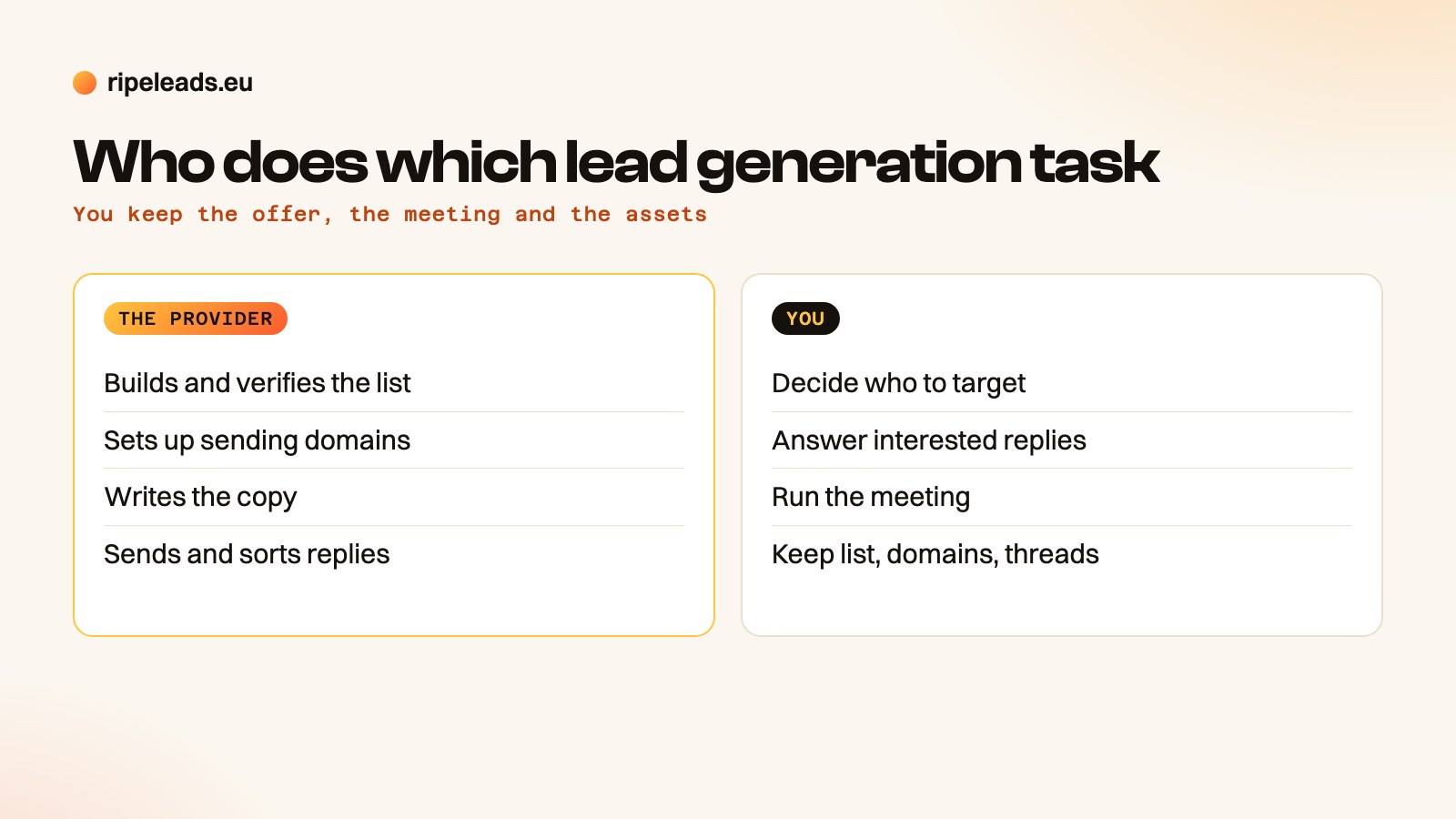
Outsourced lead generation means paying an outside team to find, contact and qualify potential buyers while you keep the sales conversation. It works when the split is clear: the provider runs research, sending and reply sorting, and you keep the offer, the meeting and the assets the campaign builds. Before you sign, check that the target list, sending domains and reply threads come back to you if you leave.
On this page
What does outsourced lead generation mean?
Outsourced lead generation means an outside team does the work of finding companies and people who might buy, contacting them and sorting who answers. You keep the offer, the sales conversation and the close. The term covers several different arrangements, which is why two quotes for "outsourced lead generation" can describe different jobs.
Providers selling under this name include agencies, software platforms, pay-per-lead marketplaces and call centres, and what a lead generation company is compares the four. This page is about the agency model, the system run for you, because that is where the split of work matters most.
How do you outsource lead generation, step by step?
1. Define the goal and the meeting. Write down what counts as a meeting you want: who attends, from which kind of company, with what authority. Without this, a provider can only report activity.
2. Check the offer. A weak offer stays weak when someone else sends it. If you cannot say in one sentence who it is for and why they would change supplier, fix that first.
3. Brief the provider. Hand over your ideal customer, the companies you never want contacted and the claims you can prove. B2B lead generation in the UK: what works in 2026 covers the full brief. At Ripe Leads, any company or segment you name stays off the list.
4. Agree the split. Use the table in the next section and settle every row in writing before kickoff.
5. Run a month-one check. Month one is setup, so the question is whether the list, domains and copy are ready and sending has started.
6. Review on replies. From then on, judge the provider by people reached, replies and positive replies per campaign. The last section covers how.
What do you hand over and what do you keep?
This is the table most vendor pages leave out. The first two columns describe the sensible split in general terms. The last column states what Ripe Leads does, taken from our pricing page.
| Task | Provider | You | At Ripe Leads |
|---|---|---|---|
| Who to target | Proposes | Decides | We build around your ideal customer profile; any company or segment you name stays off the list |
| List building | Builds | Reviews | Public registers, company websites, job adverts and public professional profiles, built fresh per client |
| Address verification | Does it | Asks for proof | Every address is verified before a send |
| Sending infrastructure | Sets up and runs | Owns the result | Dedicated domains registered for you, SPF, DKIM and DMARC on each, two weeks of warm-up, mailboxes included |
| Copy | Writes | Approves the claims | Written in the buyer's language |
| Sending and follow-ups | Runs | Watches | The sequence and follow-ups are ours |
| Reply sorting | Does it | Spot-checks | Replies are sorted for you |
| Answering interested replies | Passes them on | Answers | Every interested reply is forwarded to your inbox |
| The meeting | No | Runs it | You bring someone who can run it |
| Closing | No | Does it | We hand over interested replies, you close |
Two rows decide most outcomes. The first is the targeting decision, because only you know which customers you want. The second is the meeting: the provider cannot attend it for you, so the speed at which your team answers an interested reply sets the result. The cost side of the same decision is in the in-house versus agency cost comparison.
Which five assets must come back to you?
A campaign builds five things that outlast it: the target list, the sending domains, every reply thread, read access to reporting, and the copy. The ownership test explains why each matters and what Ripe Leads hands over, so it is not repeated here. This page covers the handover itself.
Write the exit into the contract as a task with an owner and a date. Check whose name is on the domain registration. Under ICANN's Transfer Policy, the registered name holder is the only party who can approve a transfer to another registrar, so a domain registered in the provider's name moves only if the provider agrees.
Our own answer is on the pricing page: cancel and everything comes over to you, the list, the sending domains and every reply thread. The contract runs month by month with 28 days' notice, which leaves time for a proper handover.
What do the first 90 days look like?
With Ripe Leads, month one is the setup month. The list, the domains and the copy are built, and the first sends go out by day 14. New sending domains warm up first, so the first interested replies usually land in weeks 3 to 4. Months two and three outperform month one, because the domains are warm by then.
Two guarantees apply from month one: your first interested reply lands within 30 days of sending or month two runs free, and you can cancel any month with 28 days' notice. These timings describe our own process. Another provider's timeline depends on how it sets up domains, so ask for theirs.
Where does the handoff fail?
Outsourcing breaks at the handoff in four places. Nobody on your side can answer an interested reply and run the meeting within a day or two. The meeting is never defined in writing, so the provider reports activity. Some rows of the split table stay unsettled, and approvals sit in someone's inbox while the sequence waits. Or the exit terms are left unwritten until the day you want to leave.
Fix each one before kickoff. Whether a provider fits your market at all is a separate question, covered in when a lead generation company is the wrong choice. If you would rather build the skill yourself first, the trade-off is in done-for-you versus DIY outbound.
How do you check an outsourced provider is working?
Ask for three counts per campaign: people reached, replies and positive replies. Sends are a cost figure and say nothing about results. Then ask what each rate is divided by, because a rate on sent emails, on delivered emails and on people reached are three different numbers.
In our campaign results PDF, a reply is any answer and a positive reply is one the client marked as worth a conversation, with the denominator stated beside every rate. If the provider will not show you any of this, read the red flags.
If you hand over the meeting-booking step, see B2B appointment setting in Europe for how agencies define a qualified meeting. For a worked example of the handover, see a done-for-you B2B lead generation agency. To decide whether the constraint is demand, see AI automation or lead generation.
Frequently asked
What is outsourced lead generation?
What should you outsource in lead generation and what should you keep?
How much does outsourced lead generation cost?
How long does outsourced lead generation take to work?
Who owns the leads and data when you outsource?
What is the difference between outsourced lead generation and outsourced SDRs?
Want the system run for you and the assets kept by you?
We run targeting, data, domains, copy and follow-up as a done-for-you service. Every interested reply goes to your inbox and everything we build comes over to you if you leave. See the pricing or book a short strategy call.
Book a strategy call Or get a free target list first