


What is a lead generation company, and which kind do you need?
In short
A lead generation company finds potential buyers for your business, contacts them for you and passes you the ones who show interest. The label covers four different businesses: outbound agencies that contact buyers on your behalf, data and software platforms you operate yourself, pay-per-lead marketplaces, and call-centre telemarketers. The type decides who does the work, how you pay, and what you still own when the contract ends.
On this page
- What does a lead generation company actually do?
- The four types of lead generation company
- How do lead generation companies make money?
- Lead generation company, agency or consultant?
- The ownership test: what do you hold when you leave?
- Five questions to ask before you sign
- When is a lead generation company the wrong choice?
What does a lead generation company actually do?
Whatever the type, a lead generation company does four jobs. It finds the right companies, verifies who to contact at each, makes the contact, and hands you the replies that show interest. Providers differ in how many of the four they cover and who performs them.
Our own process maps to the four jobs directly: collect the companies that match who you sell to, qualify the list and verify every address, reach out by email and LinkedIn, then hand over every interested reply with the thread attached. A software platform sells you tools for some of those steps. A marketplace sells you the output of the first. An agency runs all four.
If you want the week-by-week view of what an agency does once you sign, read Demand generation agency: what it does and what it costs. This page covers the earlier question: which kind of provider you are buying from.
The four types of lead generation company
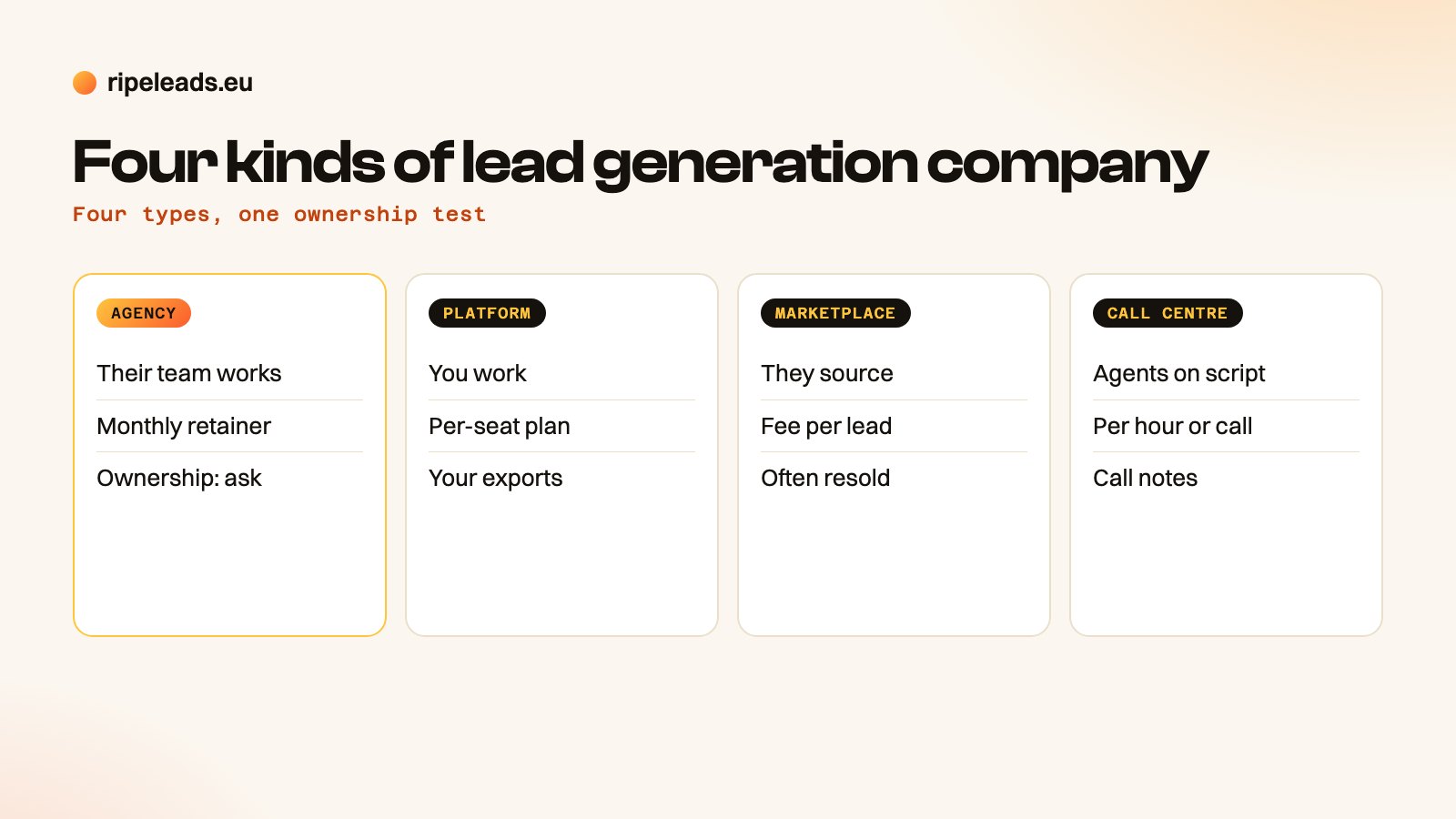
The table compares the four on who does the work, how they usually charge, what you own at the end and when each fits. Cells say "ask" where the answer changes from contract to contract.
| Type | Who does the work | Usual pricing | You own at the end | Fits when |
|---|---|---|---|---|
| Outbound agency (done for you) | The agency's team | Monthly retainer, sometimes per appointment | Depends on the contract: ask | You need meetings and have no outbound team |
| Data or software platform | You | Subscription per seat or per credit | The data you exported and your own sending setup | You already have SDRs and want better inputs |
| Pay-per-lead marketplace | The marketplace sources leads, often shared with others | Per lead | The lead record, which is often resold to others | Consumer or local-service demand with short buying cycles |
| Call-centre or telemarketing | Agents working from a script | Per hour or per booked call | Call notes, sometimes recordings | A phone-first, volume-driven offer |
Ripe Leads is an example of the first type. If you are buying a done-for-you provider for European markets, multilingual lead generation across Europe covers that case.
How do lead generation companies make money?
There are five common models: a monthly retainer, a fee per lead, a fee per booked appointment, a software subscription, and a commission on closed deals. Each pays the provider for something different, and that shapes what the provider optimises.
A per-lead fee pays for volume, so the incentive is to count more leads. A retainer pays for effort, so the incentive is to keep the work going. A per-appointment fee pays for a booked slot, so the incentive is the booking, whether or not the buyer fits. The trade-offs are laid out in pay per lead versus retainer, and the price ranges buyers see are in the agency pricing guide.
Our own price is on the pricing page: EUR 3,750 for the first month including setup and launch, then EUR 2,850 a month. It is a flat retainer with tools and data included, and no per-lead fees.
Lead generation company, agency or consultant?
In everyday use, "lead generation company" and "lead generation agency" mean the same thing, and "B2B lead generation companies" is the same phrase with the market added. The difference that matters sits inside the label: the type, meaning who does the work and what you keep.
A consultant is usually one person who advises or runs a campaign alone. An agency has a team and tooling. Consultant versus agency compares the two on cost and risk. A full-service marketing agency is a third thing again, and marketing agency versus lead generation agency explains where the scopes split.
The ownership test: what do you hold when you leave?
The question we think buyers skip is what they will own on the day the contract ends. A provider that keeps the list, the sending domains and the reply threads has also kept the work you paid for. Put the five assets below to any provider of any type.
| Asset | Why it matters | Ripe Leads answer, from our pricing page |
|---|---|---|
| Target list | It is the research you paid for and the input to your next campaign | Built around your ideal customer profile and signed off by you; on cancellation it comes over to you |
| Sending domains | A warmed domain carries sending reputation with it | Dedicated domains registered for you; on cancellation they come over to you |
| Reply threads | They hold every conversation and objection | Every interested reply is forwarded to your inbox, and every reply thread comes over on cancellation |
| Reporting | It shows what was sent, delivered and answered | Sent, delivered, replied and positive, per campaign, straight from the sending platform |
| Copy | It is the message your market has already seen | Written in the buyer's language; ask for it in writing, as the pricing page does not list it separately |
Get the answers in the contract, not on a sales call. A provider that answers "ask" in the first table row should be able to answer in writing.
Five questions to ask before you sign
- Who does the work, and are they named? You want to know whether a team, a platform or a subcontractor sends your campaign.
- What counts as a lead in the contract? An interested reply, a booked meeting and a scraped contact are three different things.
- What happens to the data and the domains when you leave? Use the ownership table above.
- How long is the notice? Ours is 28 days, which gives time for a proper handover.
- How soon will you see a first reply? Warm-up takes weeks, so a provider promising replies on day one is skipping it.
More warning signs are collected in lead generation agency red flags. What each line of a quote should cover is set out in our breakdown of lead generation services.
When is a lead generation company the wrong choice?
Four situations make it a poor buy. Your market is too small to survive a mailing, so a short list contacted once is spent. Nobody on your side can run the meetings that the replies create. You sell to consumers, where B2B outreach rules and methods do not apply. Or your offer is not yet proven, in which case getting your first B2B customers without a budget comes first.
On our strategy call we check whether your market has enough buyers for cold email and say so if it does not. The pricing page states the same.
Appointment setters are one of the four types; see B2B appointment setting in Europe for the agencies compared. If you want the managed version, see a done-for-you B2B lead generation agency. The definition behind these services is in what outbound lead generation is.
Frequently asked
What does a lead generation company do?
How do lead generation companies make money?
How much do lead generation companies charge?
Is a lead generation company the same as a lead generation agency?
Is a lead generation company worth it?
What should I own when I stop working with one?
Want us to run this for you?
We run targeting, data, copy and follow-up as a done-for-you service, and the list, the domains and every reply thread are yours if you leave. See the pricing or book a short strategy call.
Book a strategy call Or get a free target list first