


Shortening the B2B sales cycle: Where the weeks actually go
Where B2B deals quietly lose weeks
The short answer
Cycles stretch because of slow replies, vague next steps, missing decision makers and no agreed date. Each is fixable and none require pressure. Speed comes from removing friction, not from chasing harder.
On this page
- Where the weeks actually go
- Slow first reply
- No defined next step
- The wrong people in the room
- No decision date
- A worked example: where six weeks disappeared
- Measure the sales cycle before you try to shorten it
- The fix for each gap
- Write the remaining steps down together
- What does not shorten a cycle
- The European calendar you have to plan around
- Some cycles are simply long
Long sales cycles are usually not caused by hesitant buyers. They are caused by gaps nobody owns.

Where the weeks actually go
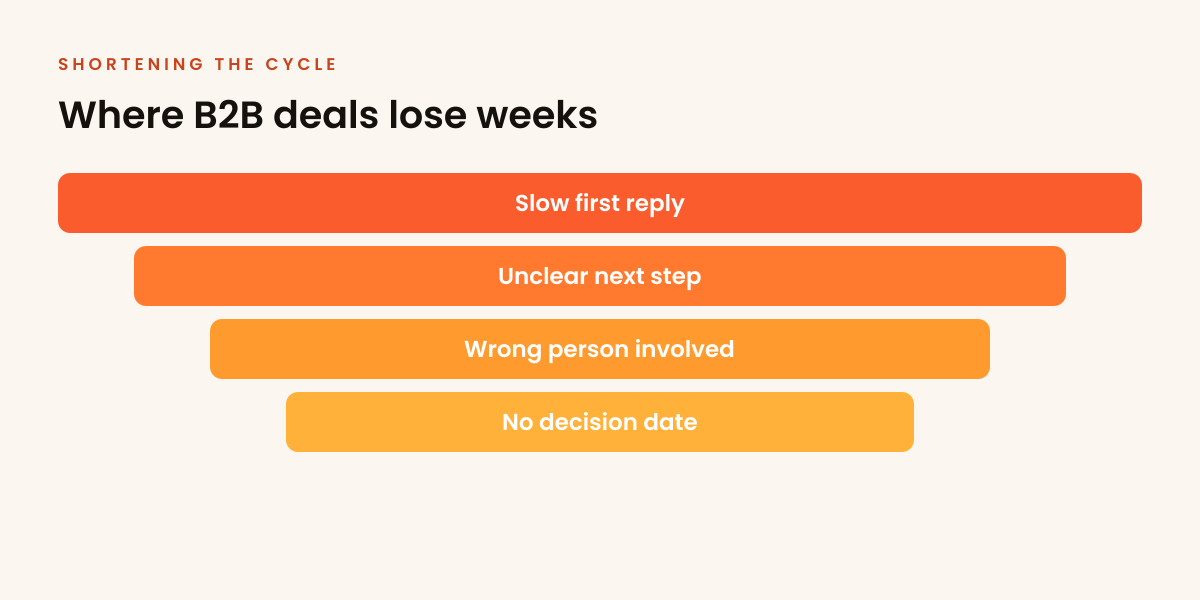
Four gaps account for most of it:
Slow first reply
The single cheapest improvement available. Interest cools fast, and a reply that takes three days meets a colder prospect than one that takes three hours. Nothing else on this list is as easy to fix.
No defined next step
A conversation that ends with "we will be in touch" has no owner and no date, so it drifts until someone remembers.
Every interaction should end with a specific next action and a specific time. This one habit removes more delay than any negotiation technique.
The wrong people in the room
If the person you are speaking to cannot decide, the deal waits for someone who was never involved. Establishing early who else needs to be part of it prevents a late-stage restart, which is one of the most expensive delays there is. This is why reaching the right person early matters.
No decision date
Without an agreed date, a deal has no reason to conclude in any particular week. Asking when they expect to decide is not pressure, it is a normal planning question, and it makes drift visible.
A worked example: where six weeks disappeared
A software vendor books a call from a cold email. The timeline that follows shows all four gaps in one deal.
The prospect replies with interest on Monday afternoon. The rep, buried in another call, answers Thursday morning. Five days gone before anything happened. The call lands the following week and goes well, ending with "send something over and we will look at it". No date attached. The proposal goes out four days later and then sits for a fortnight, because the person who received it needs a head of operations who was never in the conversation. When that person finally joins, they ask the questions from call one and the cycle restarts.
Nobody here did anything wrong, and the deal still took six weeks longer than it needed to. Each individual gap was two to fourteen days, and none of them needed a difficult conversation to close.
Measure the sales cycle before you try to shorten it
Most teams describe their sales cycle as one number and then argue about it. The number that helps is time in each stage, because that is where the fix lives, and each stage maps onto a step in the B2B buyer journey.
Track four intervals in days:
- Reply to meeting. From a positive reply to a call in the diary. Anything over five days is a leak.
- Meeting to proposal. Usually short, and usually longer than the rep remembers.
- Proposal to decision. The longest interval and the least controlled.
- Decision to signature. Legal, procurement and finance. Regularly longer than anyone plans for.
B2B cycles range from a few weeks for small single-owner purchases to six or nine months for enterprise deals with procurement involved, so external benchmarks help less than your own median. Once you have that median per stage, the argument about whether things are slow stops. The KPIs worth tracking covers what else belongs alongside it.
The fix for each gap
- Reply in hours rather than days. Route positive replies to a person, not a shared queue. When a prospect says yes covers what that fast reply should contain.
- Book the next meeting inside the current one. Both diaries are already open. "I will send some times" costs a few days every time.
- Ask who else needs to be involved on the first call. Phrase it as help: "who usually looks at something like this with you?"
- Send the proposal within 48 hours. Momentum decays fast, and a document that arrives a week later meets a colder buyer.
- Ask for the decision date out loud. "When would you want this running?" works backwards into a timeline the buyer owns.
- Start procurement early. Security reviews, legal and supplier onboarding run in parallel if you raise them before the yes. Getting through procurement explains the sequence.
Write the remaining steps down together
The strongest single tool for cycle length is a shared, dated list of the steps left, who does what, by when, through to signature. It sounds procedural, and buyers rarely object, because it makes their own internal path visible to them as well.
Sending it after a good meeting also flushes out trouble early. A buyer who will not agree to a rough date for a security review is telling you something useful in week two rather than week ten. The mutual action plan covers the format.
What does not shorten a cycle
Pressure. Artificial deadlines and repeated chasing tend to extend cycles rather than compress them, because they push buyers into defensive silence.
Removing friction works. Adding urgency to a process that is not ready usually backfires.
The European calendar you have to plan around
Selling across Europe adds structural delay that no process fix removes. August is quiet in Germany, France and Italy, so a proposal landing on 25 July frequently waits for September. The Baltics and the Nordics lose most of July the same way, and Christmas takes the last fortnight of December plus the first week of January.
That is close to two months a year where the calendar sets the pace rather than the buyer. Plan the pipeline around it: push for decisions before a break instead of through it, and treat a September restart as normal rather than as a lost deal. In DACH, works councils and data protection reviews add further weeks, and both cost far less time when raised in week one than in week eight.
Some cycles are simply long
Worth being honest: in regulated industries or with large purchases, months are normal. The goal is removing avoidable delay, not forcing a decision the organisation is not structured to make quickly.
Frequently asked
How can I shorten the B2B sales cycle?
Why do B2B deals take so long?
Does chasing harder speed up a deal?
Rather not build this yourself?
We run the targeting, data, copy and follow-up as a done-for-you service, and send the interested replies straight to your inbox. You bring the close.
Book a strategy call