


How to reduce meeting no-shows: Confirmations and reminders
An arranged call is not yet a call that happened
The short answer
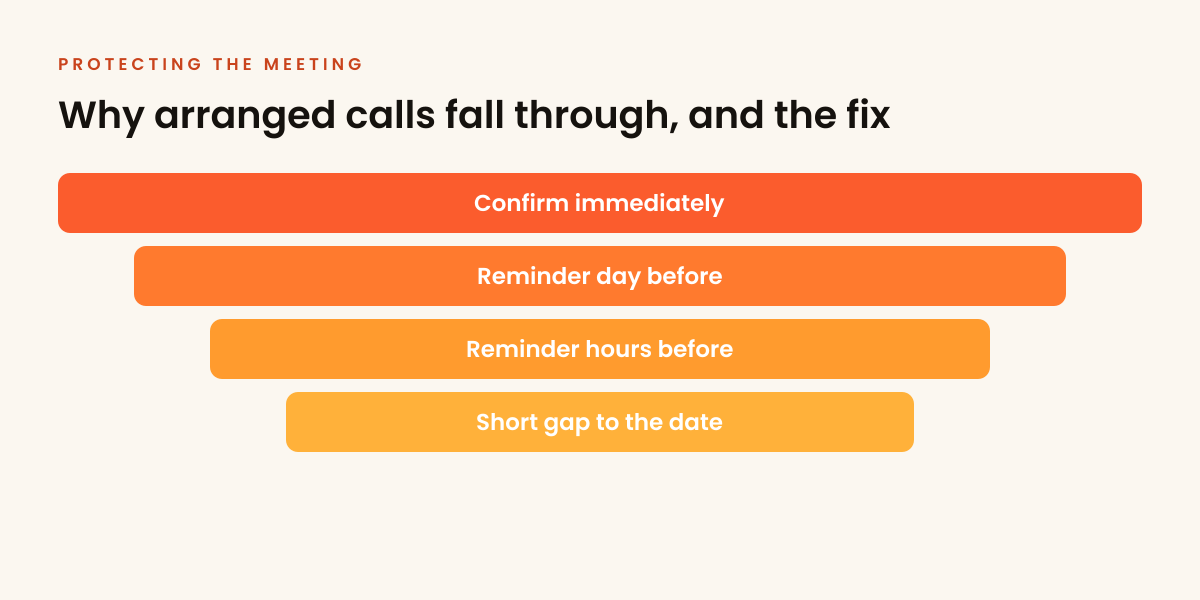
Most no-shows are forgetting, not reconsidering. Confirm immediately, remind the day before and again a few hours ahead, and keep the gap short. These dull steps recover opportunities you have already earned.
On this page
The prospect agreed, it went in the calendar, and the time arrives with nobody there. That one stings, because the hard part was already done.

Why people miss calls
Rarely a change of mind. Usually it is forgetting, interest cooling because too much time passed, or the call getting buried under other work.
- Forgotten, lost among other commitments.
- Cooled off, too long between agreeing and meeting.
- Never firmly agreed, a vague yes rather than a specific time.
What no-show rates look like
Set expectations before trying to fix anything. Meetings booked from cold outreach no-show far more often than meetings from referrals or inbound, and losing a meaningful share of them is normal for cold-sourced calls with no confirmation discipline behind them. Warm and referred meetings hold far better, which is why comparing the two in one number hides the problem.
Teams that confirm properly and remind twice tend to pull the cold-sourced number down substantially, and in our own campaigns that is the single cheapest improvement available. That is the size of the prize: a chunk of the meetings you already earned, recovered with three short messages and no extra prospecting.
Measure it as its own metric on your outbound reporting dashboard rather than folding it into pipeline reporting. Booked meetings and held meetings are different numbers, and only one of them can turn into revenue. If your CRM hygiene does not distinguish the two, the no-show problem stays invisible.
Confirm while it is warm
Confirm straight after agreeing, with the date, time and what the call will cover. A loose arrangement with no confirmation is a half-arrangement, and half-arrangements are easy to forget.
The confirmation has four jobs, and it can do all of them in five lines: restate the exact date and time with the time zone spelled out, name what you will cover, say how long it will take, and include the joining link. Something like: "Thursday 14 August, 10:00 CET, 25 minutes. Link below. Plan is to go through how you are currently sourcing welders and where the gaps are, then a short view of what we would do differently. If that timing slips, reply with a better slot."
That last sentence matters more than it looks. Giving explicit permission to move the call is what converts a silent no-show into a reschedule, and a reschedule is a live opportunity while a no-show is usually a dead one. Naming the agenda also raises attendance on its own, which is the argument for a proper pre-meeting agenda.
Two reminders
The day before, so it enters tomorrow's plan. A few hours ahead, as the final nudge. Keep both short and easy to confirm or move, and make them helpful rather than accusatory. This single habit removes a large share of no-shows.
Write them as if you assume the meeting is happening, because assuming it is not invites the cancellation. The day-before message can be two lines: the time, the link, and one sentence on what to have ready. The same-day message can be one line with the link, sent two to three hours ahead rather than fifteen minutes ahead, when it is already too late for the person to rearrange anything.
Send them from the same thread and the same address that booked the meeting. A reminder arriving from an automation tool the prospect has never seen reads as a mass mailing and gets ignored by exactly the people you are trying to reach.
Short gap, chosen time
Two things reduce risk before any reminder exists: a short gap between agreeing and meeting, and letting the person pick the slot themselves. Someone who chose their own time, soon, turns up far more reliably.
Aim for two to four working days between the yes and the call. Same-day feels rushed and gives no room to prepare; two weeks out gives interest time to evaporate and a dozen other priorities time to arrive. If the only slot that works is far away, keep the thread alive with something small in between rather than going quiet.
The booking mechanism carries real weight here. A link showing genuine availability in the prospect's own time zone, with a confirmation email and a calendar file attached, removes most of the friction that produces accidental no-shows. The details are covered in the booking link that gets used, and time zone handling in outbound across time zones. A meeting agreed by a Lithuanian team with a German prospect that lands an hour off because nobody wrote CET is a no-show nobody intended.
What to do when someone does not show
Wait five minutes, then send one short message on the original thread. No reproach, no guilt, just an offer of two alternative times. Most people who miss a call are embarrassed rather than uninterested, and a friendly message gives them an easy way back.
If that goes unanswered, one more attempt a few days later and then park the contact for later nurture. Two missed calls with no explanation is a signal about priority, not a puzzle to solve with a third message.
Mistakes that cause avoidable no-shows
- Accepting a vague yes. "Sometime next week works" is not a booking. Fix: never end the exchange without a specific date, time and time zone.
- Relying on the calendar invite alone. Invites get auto-accepted and never read. Fix: a human message alongside the invite, every time.
- Reminders that sound like a warning. "Just making sure you do not forget" puts the prospect on the defensive. Fix: lead with what they get from the call.
- Booking with the wrong person. Someone with no authority and no problem to solve agrees easily and attends rarely. Fix: qualify while handling the positive reply, before the slot is booked.
- Long gaps with silence. Fix: if the call is more than a week out, send something useful in between.
- No fallback channel. Fix: capture a phone number at booking so a missed video call can become a two-minute call instead of nothing.
Why it is worth the effort
Every call that happens is a real opportunity. Cutting no-shows increases the number of conversations without adding a single new contact, which makes it one of the cheapest improvements available anywhere in the process.
Frequently asked
Why do prospects miss calls they agreed to?
How do I reduce no-shows?
When should I send meeting reminders?
Rather not build this yourself?
We run the targeting, data, copy and follow-up as a done-for-you service, and send the interested replies straight to your inbox. You bring the close.
Book a strategy call