


Outbound or inbound: which one fits where you are
The short answer
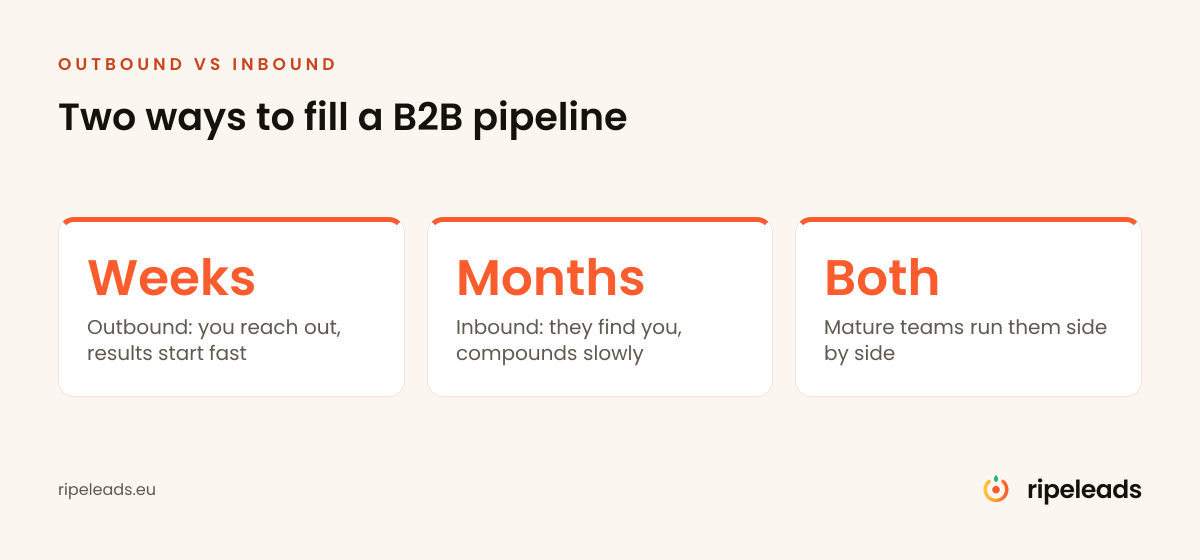
Outbound means you reach out and results start in weeks, with full control over who you target. Inbound means they find you, which compounds cheaply but slowly over months. Most growing B2B companies start with outbound and build inbound alongside it.
On this page
- The actual difference
- Where outbound is stronger
- Where inbound is stronger
- What each channel actually costs
- A worked comparison
- Why most companies start with outbound
- They feed each other
- A realistic expectation
- How to split effort between the two
- Mistakes when choosing between outbound and inbound
- How this plays out in European markets
The question is usually framed as a choice. It is closer to a sequencing decision.

The actual difference
Direction, and everything that follows from it:
- Outbound, you contact them. Fast to start, controllable, needs ongoing work.
- Inbound, they contact you. Slow to build, cheap once running, compounds. The broader version of the same split is demand generation versus lead generation.
Where outbound is stronger
When you need conversations in weeks rather than quarters, when you know exactly which companies you want, or when you are entering a new market and need to test whether anyone cares. You choose the targets, so you get a clean read on a specific segment.
Where inbound is stronger
When you can invest months before it pays, and want a durable, low-cost flow later. Content and search compound: the work you do this quarter keeps returning next year, which is the whole case for SEO as a B2B lead source. It is the better long-run economics and the worse short-run answer.
What each channel actually costs
The cost comparison is usually made badly, because the two channels spend different things. Outbound spends money per month and produces meetings roughly in proportion to spend. Inbound spends time up front and produces nothing for a while, then produces leads with almost no marginal cost. How the outbound spend is structured, per lead, per meeting or as a flat retainer, decides what the provider optimises for.
Honest shapes from running both: cold email reply rates on a well-built list are a small share of what you send, and positive replies are a fraction of that again, so meeting volume tracks list size and sending capacity closely. Inbound content pays back over quarters rather than weeks, and slower still in a language with thin search volume. If you need planning figures, take the reply rate from your own last campaign and, for inbound, the date your competitors' best-ranking pages were published. Planning against your own evidence beats planning against a best case. Both sums assume demand is the constraint, and when the real constraint is your team's capacity to handle what already arrives, the money belongs in automation before either channel.
Set the comparison on cost per meeting rather than cost per lead, since inbound produces a lot of low-intent traffic and outbound produces few but qualified conversations. The pricing breakdown covers what a managed outbound programme costs, and the same arithmetic applies whether you run it in-house or not. Offline channels belong in the same table, where a stand at a fair usually carries the highest cost per qualified conversation of anything a B2B team buys.
A worked comparison
Take a twelve-person B2B software firm in Vilnius selling to logistics operators across Poland and Germany, with two quarters of runway and no marketing hire.
The inbound path: hire or contract a writer, publish weekly, wait. By month nine there might be enough organic traffic to matter, in three languages, in a niche where the total monthly search volume for the relevant terms is a few hundred queries. The runway ends before the channel starts.
The outbound path: build a list of roughly 1,200 logistics operators above 50 employees, warm domains for three weeks, send from month two. By month three the founders have had twenty conversations, learned that nobody cares about the feature they built the company around, and heard the same operational complaint eleven times. That complaint becomes the homepage, the sales deck and the first six articles.
The second path is not better because outbound outperforms content. It is better because it produced information while there was still time to act on it.
Why most companies start with outbound
Early on, time is the binding constraint. Outbound produces conversations while inbound is still finding its footing, and those conversations teach you what your market responds to.
That learning then makes the inbound work better, because you are writing about problems you have heard stated in real words.
They feed each other
Outbound tells you which messages land, which sharpens your content. Content warms the accounts you are contacting, so your outreach stops feeling cold. Running both is not duplication, it is compounding.
A realistic expectation
Outbound is not instant either. Domains need warming, sequences need to run, and the first interested replies typically appear a few weeks in. Anyone promising immediate results is describing something other than outbound.
How to split effort between the two
A split that holds up for most B2B companies under fifty people:
- Months 1 to 3: outbound only. One narrow segment, one offer, enough volume to get a readable signal. Write down what you expect to happen so you can tell later whether it did.
- Months 3 to 6: outbound plus capture. Keep sending, and fix the things a curious prospect hits after a reply: the site, the case detail, the booking link. Most early inbound is not content, it is not losing the people outbound already warmed. That is also the one place a chatbot on a pricing or demo page earns its keep.
- Months 6 to 12: outbound plus deliberate content. Write only about the problems you heard stated on calls, in the words prospects used. Ten specific pages beat fifty generic ones.
- Month 12 onwards: rebalance on evidence. If organic is producing qualified conversations at a lower cost per meeting than outbound, shift budget. If it is producing traffic and no pipeline, it is a brand exercise, not a channel.
Track both against the same benchmarks. A channel without numbers attached will always be defended on feeling.
Mistakes when choosing between outbound and inbound
- Judging outbound on week two. Warm-up, sequence length and follow-up mean the first honest read comes at week six to eight, not on the first send.
- Judging inbound on month three. The channel has not started yet. Killing it there wastes the only part that compounds.
- Running both at half strength. Two underfunded channels produce two ambiguous results. Fund one properly first.
- Treating inbound as free. A writer's time, a designer's time and founder review hours are real costs, they are just not on an invoice.
- Buying traffic and calling it inbound. Paid search stops the day you stop paying, which makes it closer to outbound economics with less targeting control.
- Skipping the segment decision. Both channels fail against a vague audience. Defining the ICP comes before either one.
How this plays out in European markets
Search volume decides much of it. In English-language software markets inbound has enough demand to justify the wait. In Lithuanian, Latvian, Estonian or a narrow Polish industrial niche, the total addressable search volume can be a few hundred queries a month, which caps inbound no matter how good the writing is. Outbound has no such ceiling, because the list is the market rather than the people already searching.
DACH sits in between: real German-language search demand exists, and so does a strong preference for a known name, which makes the two channels genuinely complementary. A prospect who has seen your name once accepts a cold email far more readily. Multi-country selling adds another argument for outbound first, since building content in four languages is four times the cost of building a list in four languages. The regional detail is in multilingual lead generation across Europe.
Frequently asked
What is the difference between outbound and inbound lead generation?
Which is better for a B2B startup?
Can outbound and inbound work together?
Rather not build this yourself?
We run the targeting, data, copy and follow-up as a done-for-you service, and send the interested replies straight to your inbox. You bring the close.
Book a strategy call