


A go-to-market strategy that survives contact with the market
The short answer
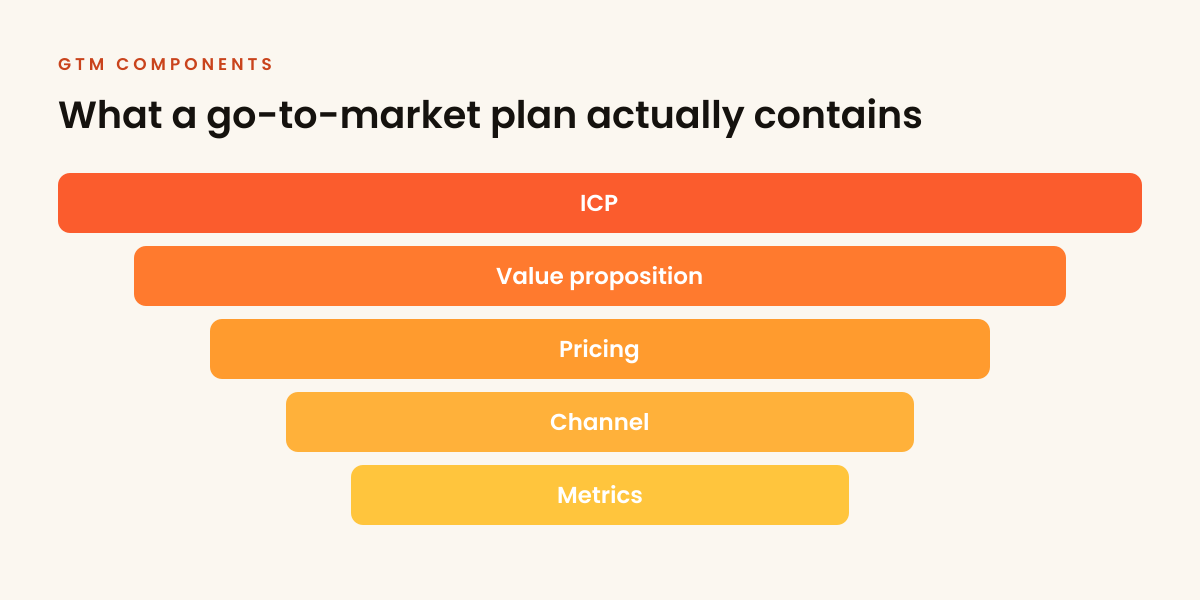
A GTM plan answers who you sell to first, what you say, how you price it, which channel you use and how you will know it is working. The plan is not the point: validating demand cheaply is, and a small outbound campaign does that faster than another quarter of planning.
On this page
- What a GTM plan actually contains
- It starts with who, not how
- Choosing the first channel
- Validate before you commit
- Measure the leading indicators
- A worked example: a six-week GTM test
- Common go-to-market mistakes, and their fixes
- If you are thinking "we need the full plan first"
- Entering a new country
- Sequencing the first year
- The common failure
A great product with no plan for reaching its market stays a secret. Most go-to-market documents fail not because they are wrong but because they never turn into contact with a real buyer.

What a GTM plan actually contains
Five parts. Miss one and the launch becomes guesswork:
It starts with who, not how
The order matters. Define the ideal customer and the value you offer them before choosing tactics. Teams that start from the channel end up with an efficient way of reaching the wrong people.
Choosing the first channel
A new offer does not need every channel, it needs one that produces feedback quickly. Two questions decide it: where does your buyer already spend attention, and how fast do you need to learn.
For most B2B launches that points to outbound, because you can pick exactly which companies to approach and get a signal within weeks instead of waiting for content to gain traction; the cost comparison between outbound and paid ads usually points the same way.
Validate before you commit
The expensive mistake is building or spending heavily before confirming anyone wants this, which is why product-market fit belongs before outbound. A focused campaign into one narrow segment is the cheapest test available.
If people reply and recognise the problem, you can invest with more confidence. If it is silence, you learned that for the price of a few hundred emails rather than a year of runway.
Measure the leading indicators
Early on, revenue is a lagging signal that arrives too late to steer by. Watch the inputs instead: how many right-fit companies you reached, what share replied, how many turned into real conversations. Those move first and tell you where to adjust.
A worked example: a six-week GTM test
Say a software firm has built a scheduling product for field-service companies and wants its first commercial segment. A planning-heavy team would spend the quarter on decks. A market-contact team would run this instead:
- Weeks 1-2: pick one narrow segment, for example HVAC contractors with 20 to 200 employees in one country. Write one value proposition aimed at their specific scheduling pain. Build a list of 300 to 500 companies and set up the sending infrastructure.
- Weeks 3-5: run the campaign. Read every reply, including the negative ones, because objections are market research you did not have to pay for.
- Week 6: decide. Replies above roughly 2 to 3 percent with recognition of the problem: invest in the segment. Polite indifference: change the message or the segment, not the whole company.
Total cost: a few weeks and a modest budget. Compare that with discovering the same answer after hiring two salespeople. The same logic applies with almost no budget at all, as we cover in first customers without a budget.
Common go-to-market mistakes, and their fixes
- Launching to everyone. "SMBs and enterprises across Europe" is not a segment, it is an absence of choice. Fix: one vertical, one size band, one country first.
- Choosing the channel by fashion. Content, paid, outbound and partnerships each fit different buyers and timelines; the trade-offs are laid out in outbound vs. inbound lead generation. Fix: pick for feedback speed, add channels later.
- Perfecting pricing before contact. Pricing debated in a meeting room is fiction. Fix: pick a defensible number, state it, and let the first twenty conversations correct it.
- Measuring only revenue. Revenue lags a B2B sales cycle by months. Fix: track reach, reply rate and meetings as leading indicators, the way our note on the KPIs worth tracking lays out.
- Treating the plan as finished. A GTM strategy is a draft the market edits. Fix: schedule a revision after every 200 to 300 contacts.
If you are thinking "we need the full plan first"
The instinct is understandable: a launch feels safer with every question answered. The reality is that half the questions cannot be answered from inside the building. Which objection kills deals, which title replies, what buyers compare you against, all of that only surfaces on contact with the market. A B2B go-to-market strategy needs enough definition to run a controlled test, not enough to survive a board review. Plan the first 500 conversations properly and let those conversations write the rest of the document.
Entering a new country
For European expansion the principles hold, but language and local context decide whether the message lands. A translated message that reads as foreign gets dismissed regardless of how good the offer is.
This is one reason we work strongest in the Baltics and in German-speaking markets: local language and local context, not just translation.
Sequencing the first year
A go-to-market strategy is not one launch, it is a sequence of bets. A pattern that holds across most B2B companies we run campaigns for: one segment and one channel until it produces repeatable meetings, then a second segment on the proven channel, then a second channel on the proven segment. Change one variable at a time, or you will never know what worked.
Resist the temptation to parallelise everything in month one. Three half-run channels produce noise; one properly run channel produces a decision. The teams that reach repeatability fastest are rarely the ones that started widest, they are the ones that killed weak segments quickly and doubled down early on the segment that answered.
The common failure
A polished strategy document that never becomes a campaign. The value is not in the plan, it is in the first real conversation with a buyer, which is also the point at which the plan starts being corrected by reality.
Frequently asked
What is a go-to-market strategy?
How do I choose the first sales channel?
How can I validate demand before investing heavily?
Test your market before you commit
We can run a focused campaign into one segment so you learn whether the demand is real, and hand you the interested replies directly.
Book a strategy call