


How many cold emails per day is actually safe
The short answer
A warmed mailbox safely sends a few dozen cold emails a day, and a new mailbox starts at 10 to 20 after two weeks of warm-up. When you need more reach, add warmed mailboxes instead of pushing more through one. Volume without targeting damages reputation and reply rate. Set your own cap below the sending tool's limit, and drop back a step if deliverability wobbles.
"The more I send, the more replies I get" is intuitive, and in cold email it is close to the opposite of the truth.

On this page
- The per-mailbox ceiling
- Scale sideways, not up
- Why more is usually worse
- A safe sending ramp, week by week
- The sending ramp for a new mailbox, week by week
- Working out how many mailboxes you need
- How many mailboxes you need: the arithmetic
- Signals you are already sending too much
- Common sending volume mistakes
- "But I see agencies sending thousands a day"
- How this plays out in European markets
- Let list quality set the volume
- Frequently asked
The per-mailbox ceiling
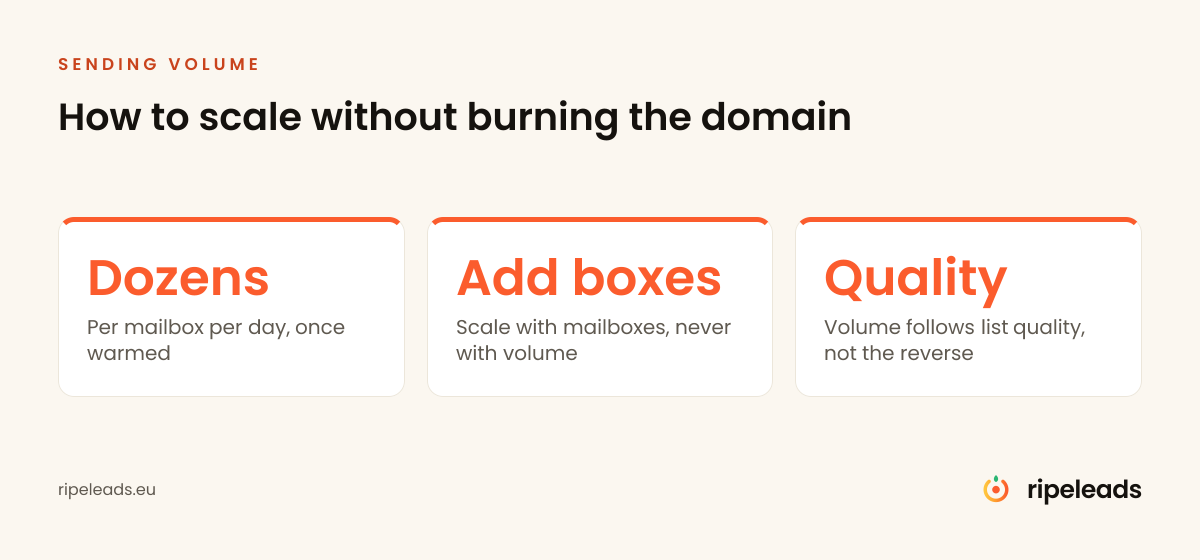
A warmed mailbox can sustain a few dozen cold emails a day. A new one should start at roughly 10 to 20 while it is being warmed up. The limit is not the tool, it is what mailbox providers consider normal human behaviour.
Scale sideways, not up
The way to increase reach is more warmed mailboxes each sending a safe amount, not one mailbox sending more. Total volume grows and every individual sender stays under the threshold.
Each new mailbox needs its own warm-up before joining a campaign. Skipping that reintroduces exactly the risk you were avoiding.
Why more is usually worse
High volume without tight targeting means more mediocre messages going to people who do not fit. That drives down reply rates and drives up bounces and complaints, which mailbox providers read as a signal about you.
So the damage is double: worse campaign results now, worse deliverability later.
A safe sending ramp, week by week
Sending volume is earned, not declared. A new domain and mailbox pair has no history, and mailbox providers treat unknown senders with suspicion until behaviour proves otherwise. A ramp that respects that looks like this:
- Weeks 1 to 2: warm-up only. No campaigns. The mailbox exchanges low-volume, natural-looking mail so providers see engagement before they see outreach.
- Weeks 3 to 4: first campaign sends. Start around 10 to 20 cold emails a day per mailbox, on top of continued warm-up activity.
- Weeks 5 to 6: gradual increase. Add a handful of sends per day each week, watching bounces and replies as you go.
- Week 7 onwards: cruising level. Settle at a few dozen a day per mailbox and hold there. This is the ceiling, not a checkpoint.
If deliverability wobbles at any stage, drop the volume back a step and hold until it recovers. Pushing through a wobble is how domains get burned.
The sending ramp for a new mailbox, week by week
Sending volume is earned, not declared. A new domain and mailbox pair has no history, and providers treat unknown senders with suspicion until behaviour proves otherwise.
| Weeks | What the mailbox does | Cold emails per day |
|---|---|---|
| 1 to 2 | Warm-up only: low-volume, natural-looking mail so providers see engagement | None |
| 3 to 4 | First campaign sends, on top of continued warm-up | 10 to 20 |
| 5 to 6 | Gradual increase: add a handful of sends a day each week while watching bounces and replies | Rising toward a few dozen |
| 7 onwards | Cruising level; this is the ceiling, not a checkpoint | A few dozen |
If deliverability wobbles at any stage, drop the volume back a step and hold until it recovers.
Working out how many mailboxes you need
Once the per-mailbox ceiling is fixed, capacity becomes arithmetic. Say you want to reach 1,000 prospects a month with a four-email sequence. That is roughly 4,000 sends, or about 200 per working day. At a safe few dozen sends per mailbox, that means somewhere between six and ten warmed mailboxes, spread across two or three separate sending domains so no single domain carries the whole campaign.
Most teams get this backwards: they pick a volume target first and hope the infrastructure copes. Plan it the other way, from mailboxes up. The full method, including how to phase new domains in, is in how many mailboxes you need.
How many mailboxes you need: the arithmetic
Once the per-mailbox ceiling is fixed, capacity is arithmetic. Plan from mailboxes up, not from a volume target down.
| Step | Example |
|---|---|
| Prospects to reach in a month | 1,000 |
| Sequence length | Four emails |
| Total sends | About 4,000 a month |
| Sends per working day | About 200 |
| Safe sends per warmed mailbox | A few dozen |
| Warmed mailboxes needed | Six to ten, spread across two or more domains |
Each new mailbox needs its own warm-up before joining a campaign. For the warm-up method, see email domain warm-up.
Signals you are already sending too much
Sender reputation degrades quietly before it collapses. Watch for these:
- A bounce rate that keeps climbing week on week. Providers read hard bounces as evidence of a scraped or guessed list, so the trend matters more than any single figure.
- Spam complaints approaching the 0.3% threshold. Past it, bulk sender rules make filtering close to automatic.
- Reply rate falling while volume holds steady. The most common early sign that more mail is landing in spam.
- Warm-up tools reporting more messages rescued from junk folders. A direct read on where your mail is landing.
Any one of these is a reason to pause and investigate, not to push harder. Ongoing checks are covered in monitoring deliverability.
Common sending volume mistakes
- Blasting a fresh domain. Hundreds of sends in week one is the fastest way to lose a domain. Fix: warm up first, always.
- Treating the tool's limit as the safe limit. Sending platforms let you schedule far more than providers tolerate. Fix: set your own caps below the tool's.
- Ramping every mailbox at once. If something goes wrong you cannot tell which variable caused it. Fix: stagger new mailboxes by a week or two.
- Ignoring send spacing. Fifty emails fired in one minute looks like a machine. Fix: spread sends across the working day with randomised gaps.
- Counting follow-ups as free. Every step in a sequence is a send against the daily cap. Fix: budget the full sequence, not just email one.
"But I see agencies sending thousands a day"
They are, across dozens or hundreds of mailboxes, each one held under the same per-mailbox ceiling described here. The headline number is an aggregate, not a trick that bypasses provider limits. Some volume shops do burn domains and treat them as disposable; that model produces terrible reply rates and drags the sender's brand through spam folders. It is not a model worth copying, and it does not survive contact with a niche B2B market where the list of relevant companies is finite.
How this plays out in European markets
In the US, a broad ICP can justify big infrastructure because the addressable list runs to tens of thousands of companies. In most European niches it does not. A campaign into the DACH region or the Baltics often targets a few hundred to a few thousand relevant firms in total, which means the constraint on volume is the market, not the mailbox count. Burning through that finite list with high-volume, low-relevance sends is unrecoverable in a way it never is in a huge market. GDPR adds a second reason for restraint: legitimate interest is far easier to defend when outreach is targeted and modest than when it is indiscriminate, and German law sets a higher bar again.
Let list quality set the volume
The better question is not "what is my maximum?" but "how many genuinely relevant contacts do I have?" Volume should follow list quality. Reaching 200 well-matched companies properly beats spraying 2,000 badly.
Frequently asked
How many cold emails can I send per day from one mailbox?
How many cold emails per day from a new domain?
How do I increase cold email volume safely?
Does sending more cold emails get more replies?
How many mailboxes do I need for cold email?
How do I plan outbound sending capacity?
What is inbox rotation in cold email?
Does inbox rotation let me send spammy campaigns safely?
We manage the sending infrastructure
Multiple warmed domains and mailboxes, volume kept inside safe limits, so reach grows without putting your reputation at risk.
Book a strategy call Or get a free target list first