


B2B keyword research for a services firm: the words your buyers type
In short
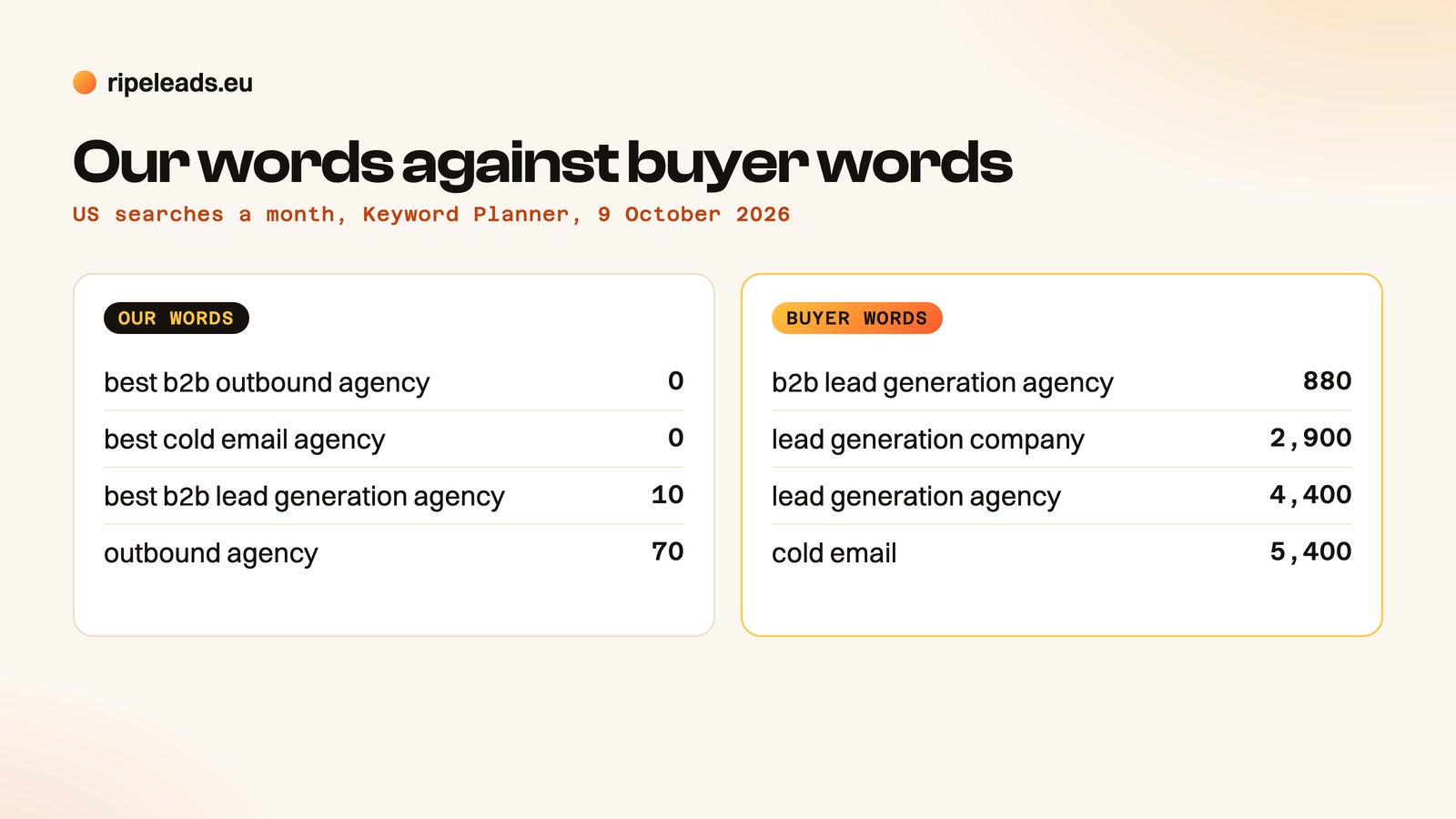
B2B keyword research for a services firm starts with an awkward finding: the phrases you use about yourself are often phrases nobody searches. In Google Keyword Planner on 9 October 2026, "best b2b outbound agency" and "best cold email agency" showed 0 monthly searches in the US, the UK and Australia, while "lead generation agency" showed 4,400 in the US and "cold email" 5,400. Check every term in Keyword Planner and in your own Search Console, give each search intent one page, and expect real queries that the planner reports as zero.
On this page
- Why B2B keyword research looks different
- The words we used and the words buyers type
- A zero in Keyword Planner can still bring impressions
- Start keyword research in your own Search Console
- Country and language change the answer
- One page per query cluster
- A keyword research routine for a B2B services firm
- The same words belong in your outreach
Why B2B keyword research looks different
B2B keyword research is the work of finding the phrases business buyers type when they look for a supplier like you, and checking how many people type them. For a services firm the numbers come out small and lumpy, and many of the phrases you would guess come back at zero.
Keyword Planner reports monthly searches in rounded bands: 10, 20, 30, 40, 50, 70, 90, 110 and up. A niche B2B phrase often lands at 0 or 10, and the difference between those two bands tells you little. The planner is still the best free volume source we have, and our own Search Console is the check on it. This page walks through what both showed for Ripe Leads, a lead generation agency, with every figure pulled on 9 October 2026.
The words we used and the words buyers type
Agencies describe themselves with words their buyers do not type. We called ourselves an outbound agency and wrote comparison pages titled "best ... agency". The planner disagreed:
| Phrase | US searches a month | UK searches a month |
|---|---|---|
| best b2b outbound agency | 0 | 0 |
| best cold email agency | 0 | 0 |
| best outbound agency | 0 | 0 |
| best b2b lead generation agency | 10 | 10 |
| outbound agency | 70 | 20 |
| b2b lead generation agency | 880 | 390 |
| lead generation company | 2,900 | 880 |
| demand generation agency | 2,900 | 390 |
| lead generation agency | 4,400 | 1,600 |
| cold email | 5,400 | 880 |
Two patterns stand out. Buyers type the plain noun, "lead generation agency", and leave out "best". And "outbound" is industry language: 70 searches a month in the US against 4,400 for "lead generation agency". If you named your service pages in your own vocabulary, rename them in the buyer's.
Search Console agrees with the planner on "best". In the 28 days to 7 October, 62 different queries starting with "best" showed our pages 357 times and produced 0 clicks.
A zero in Keyword Planner can still bring impressions
The planner shows 0 for "lead generation for staffing agencies" in the US, the UK and Australia, and 0 for "lead generation agency for recruitment agencies". Search Console tells a different story for our staffing lead generation page. In the 28 days to 7 October, Google showed our pages for "lead generation for staffing companies" 47 times, for "lead generation for recruitment agencies" 46 times and for "lead generation for staffing agencies" 39 times.
Those are impressions for one small site, at positions around 20 to 24. The real number of searches is higher. For niche B2B terms, treat a planner zero as unknown and let Search Console settle it once you have a page that can rank.
Start keyword research in your own Search Console
Your Search Console already lists the queries Google connects to your site. In the 28 days to 7 October 2026, ours held 1,261 distinct queries. Three groups were worth knowing about:
- Brand. "ripe leads" brought 208 impressions and 25 clicks at position 1.2. People who already know your name find you.
- "Best" lists. The 62 "best" queries above: 357 impressions, no clicks.
- Long questions. 355 queries of eight words or more, written like questions to an AI assistant, such as "which outbound sales agencies specialize in hard-to-reach manufacturing buyers?". Together they brought 2,398 impressions and 0 clicks.
The long questions tell you how buyers describe their problem, in their own words, with the industry and the obstacle named. You will not find them in the planner. They make good H2 headings and FAQ questions, because they match the way buyers ask.
Country and language change the answer
The same service has different search terms in each market. A few examples from the same pull:
| Market | Phrase | Searches a month |
|---|---|---|
| Germany | kaltakquise | 5,400 |
| Germany | neukundengewinnung | 2,400 |
| Germany | leadgenerierung agentur | 590 |
| Germany | outbound agentur | 10 |
| Germany | beste leadgenerierung agentur | 0 |
| Australia | lead generation perth | 110 |
| Australia | lead generation agency australia | 50 |
| Lithuania | b2b pardavimai | 210 |
| Lithuania | potencialių klientų paieška | 0 |
German buyers search for the activity ("kaltakquise", cold acquisition) far more than for an agency. Australians add a city. Lithuanian buyers search for B2B sales in general, and the literal translation of "lead generation" returns nothing. Research each market in its own language and with its own country setting. A translated English keyword list misses most of this.
One page per query cluster
Once you know the phrases, give each search intent one page. In the 28 days to 7 October, Google showed five of our German pages for "leadgenerierung agentur", and the best of them sat at position 16. Five pages competing for one query is keyword cannibalization, and it keeps all five off page one. How we merged them, and what we still have to measure, is in our B2B SEO case study.
A keyword research routine for a B2B services firm
- Write down how your buyers describe the problem, from sales calls, email replies and the questions in your inbox. Keep their wording.
- Export your Search Console queries for the last 28 and 90 days. Sort out brand, "best" lists, long questions and plain service terms.
- Run the candidate phrases through Keyword Planner, one country and language at a time.
- Treat a zero as unknown. If Search Console shows impressions for it, it exists.
- Group phrases by intent and assign one page to each group. Merge pages that compete.
- Put the buyer's phrase in the title and the H1, and the long questions in H2s and the FAQ.
- Check the page again 28 days after you publish or change it.
The first step is the same work as defining your ideal customer profile: you cannot guess a buyer's words before you know who the buyer is.
The same words belong in your outreach
The phrase list you build for search also tells you how buyers name their problem. That is the language a cold email should use, because the reader recognises it as their own. If you would rather have that work done for you, our done-for-you B2B lead generation covers the list, the copy and the sending.
Frequently asked
What is B2B keyword research?
Why does Keyword Planner show 0 searches for my B2B keyword?
Should a B2B company target "best [service] agency" keywords?
How do you find the keywords B2B buyers use?
Do long, question-style searches show up in Search Console?
Do keywords differ by country for the same B2B service?
Want your buyers' words in front of the right companies?
We build the list, write the outreach in the buyer's language and send every interested reply to your inbox. See the pricing or book a short strategy call.
Book a strategy call Or get a free target list first