


B2B SEO case study: what we changed on ripeleads.eu, and what moved
In short
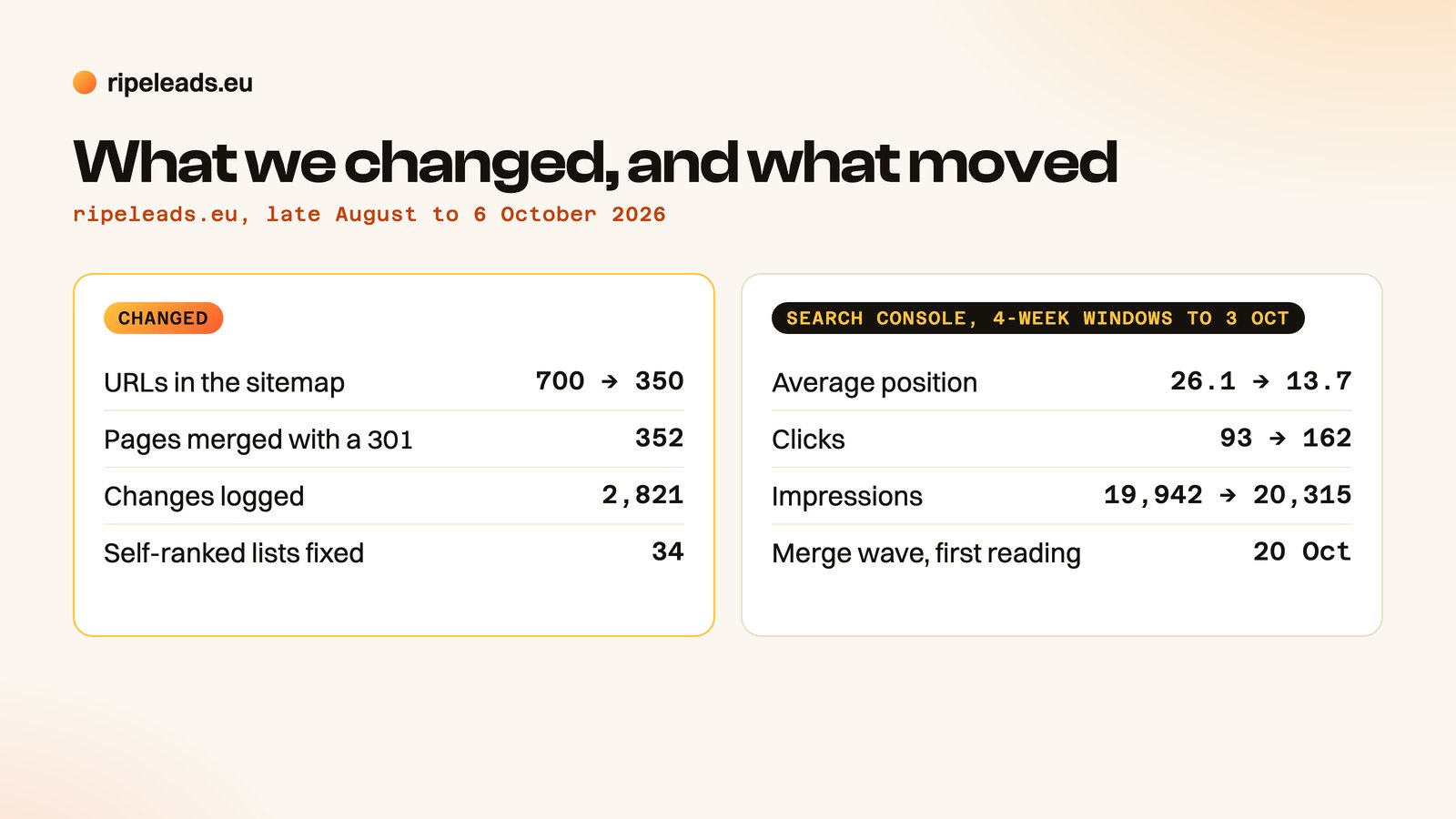
By 6 October 2026 we had cut ripeleads.eu from 700 to 350 URLs by merging overlapping pages behind 301 redirects, rewritten titles and FAQs, taken Ripe Leads out of its own ranked lists, and logged 2,821 changes, each with a date to measure it. Separately, Search Console shows average position moving from 26.1 to 13.7 and clicks from 93 to 162 between the four weeks to 5 September and the four weeks to 3 October. The waves that cut the URL count went live on 6 October, after both windows, and their first reading is due on 20 October 2026.
On this page
Where ripeleads.eu started
This is the record of what we changed on our own site for search and AI answers between late August and 6 October 2026, with the numbers we can show and the ones we cannot show yet. Ripe Leads sells outbound lead generation, and we still want buyers who search to find one clear page per question.
The site first showed up in Google in June 2026 and started collecting real impressions in the week of 20 July. By 2 October it carried 700 URLs across five languages. Many of them answered the same question. Two pages titled "Lead Generation for Professional Services", for example, or a b2b-lead-generation-<country> page next to a lead-generation-<country> page. Fifty-six pages were agency lists or "alternatives" pages.
Search Console showed the cost. In the 28 days to 7 October, Google showed five of our German pages for "leadgenerierung agentur", and the best of them sat at position 16. Five pages split one query and none of them reached page one.
Fixing keyword cannibalization by merging pages
Keyword cannibalization means several pages on one site compete for the same search. Google shows one of them at a time, and the signals a single page would collect split between them. The fix is one owner page per intent, with the others merged into it and redirected.
We grouped pages into intent clusters and picked a winner in each by a fixed rule: traction first (16 months of impressions and clicks, then position), then internal links pointing at the page, then intact language versions, then fit with the intent. We had no backlink data, so internal links stood in for it.
The main wave went live on 6 October 2026:
- 352 pages removed, each with a 301 redirect to its winner. Before launch, a check of 487 redirect rules found no missing targets, no chains and no loops.
- The same check found no page on the site linking to a removed URL.
- 114 FAQ entries and 34 sections from the removed pages moved into the winners, so the content a searcher found still exists at the new address.
- The sitemap went from 700 URLs to 350.
Deleting half a site sounds drastic. The removed pages were duplicates or pages without traction, and each one now points at the closest page that remains.
Titles, FAQs, and one title we got wrong
The same day, a second wave upgraded the pages that won. The changelog records 170 FAQ additions, 154 new or expanded sections, 147 internal link changes, 138 meta descriptions, 72 titles and 53 H1 headings across that wave. FAQ text on the page matches the FAQ schema word for word, which is the rule from our schema markup guide.
One earlier title change went wrong, and it set a rule we now follow. In September we rewrote the title of our manufacturing agency comparison and dropped the exact phrase people searched. Over 3 to 16 September the page averaged position 5.5 on 1,365 impressions. Over 17 to 23 September it averaged 20.8 on 63 impressions. We restored the phrase on 26 September, and in the first days of October it still sat at 22.8.
The rule since then: a page with clicks in the last 28 days keeps its title. We improve the body and leave the words that earn the clicks alone.
Taking ourselves out of our own rankings
On 27 August 2026 we asked ChatGPT about B2B outreach providers. It listed Ripe Leads and told the reader to "treat its self-published rankings as marketing". It had a point: 34 pages on our site named Ripe Leads inside a "best of" list, and a search for Ripe Leads with our own domain excluded returned nothing about the company.
We took Ripe Leads out of the numbered entries on those 34 pages. Each list now ends with a separate "Where we fit" block that says what we run and what we do not. We have kept that rule since.
A competitor's AI-visibility report in September found a second gap: ChatGPT described us with a single phrase, "signal-based targeting", the only phrase our homepage schema repeated. On 19 September we rewrote the homepage schema description to name all four services, expanded knowsAbout from 5 entries to 11, and brought the FAQ schema to 12 entries. On 20 September we added our public register record to the sameAs list on all five homepages. The background is in our generative engine optimization guide.
IndexNow and a log for every change
After each wave we submitted the changed URLs through IndexNow: 364 after the merge wave, 260 and 219 after the two smaller ones. The IndexNow API answered each batch with HTTP 200. IndexNow notifies Bing, Yandex, Seznam, Naver, Yep and Amazon. Google is not a participant, so Google finds changes through its own crawl and the sitemap (IndexNow FAQ).
Every change goes into a changelog with the URL, the type of change, the before and after text, the hypothesis, the query it targets and two measurement dates, 14 and 28 days after release. By 9 October 2026 the log held 2,821 changes across 768 URLs. The largest named groups: 644 internal link changes, 465 merges with a 301, 392 FAQ additions, 281 section additions, 204 meta description changes and 182 title changes.
A weekly job scores each change against Search Console once its window closes. Without it, a site that changes 2,821 things in two weeks cannot tell which one did the work.
What moved in Search Console
The table compares two four-week windows for the whole site, before and after the September changes. Data comes from Search Console, pulled on 9 October 2026.
| Window | Clicks | Impressions | Average position |
|---|---|---|---|
| 9 Aug to 5 Sep 2026 | 93 | 19,942 | 26.1 |
| 6 Sep to 3 Oct 2026 | 162 | 20,315 | 13.7 |
By calendar month, August brought 87 clicks on 20,532 impressions at position 27.2, and September 160 clicks on 22,271 impressions at position 14.4.
ripeleads.eu has collected impressions for about three months. To tell which change did what, the changelog compares each changed page with itself, 14 and 28 days after release.
What we have not measured yet
The merge wave and the upgrade wave both went live on 6 October 2026. Search Console data reaches us with a lag of a few days, so the latest full day in our pull is 6 October itself. The changelog holds no result for them yet.
The first reading is due on 20 October 2026 and the second on 3 November 2026. The 352 merges get their first numbers on those dates.
What a B2B services firm can take from this
Buyers of B2B services search with a short list of plain phrases, and our B2B keyword research notes show how few of them carry volume. A site that spreads one phrase across five pages hands the position to someone else. One page per question, with the facts a buyer needs, keeps the position in one place.
Proof from other sites counts for more than self-description, as the ChatGPT answer showed us. Listing your company where buyers compare suppliers helps a little, as we found in our free business directories test.
Search brings you the buyers who are already looking. Reaching companies that fit your offer before they search takes outbound, which is what our done-for-you B2B lead generation runs for clients selling across Europe.
Frequently asked
What is keyword cannibalization?
How do you fix keyword cannibalization?
Does deleting pages hurt SEO?
Does IndexNow work with Google?
How long until SEO changes show up in Search Console?
Should a company rank itself in its own "best of" lists?
Want buyers who are not searching yet?
Search reaches the buyers already looking. We reach the rest: the right companies, contacted in their language, with every interested reply sent to your inbox. See the pricing or book a short strategy call.
Book a strategy call Or get a free target list first