


A/B testing cold email, properly
The short answer
Change one variable at a time, start with whichever number is weakest, and run enough volume that the result is not noise. Testing five things at once produces a better campaign and no idea why.
"We changed the email and replies went up" is a nice sentence that teaches you nothing if you changed five things.

On this page
- What to A/B test first at a glance
- Fix the weakest number first
- One change at a time
- Volume decides whether it is real
- Measure the number the change should move
- What to test, in order of payoff
- A worked example: running one clean test
- Common A/B testing mistakes, and the fix
- Benchmarks: what a meaningful lift looks like
- Testing across languages and markets
- It never really finishes
What to A/B test first at a glance
| Order | Variable | Judge it on | Note |
|---|---|---|---|
| 1 | Offer | Replies and booked meetings | Highest-impact variable, rarely tested |
| 2 | Audience segment | Replies by segment | Often shows a copy problem was a targeting problem |
| 3 | Subject line | Opens | Fixes opens, not replies |
| 4 | Opening line | Replies | Decides whether the rest gets read |
| 5 | Call to action | Replies that become conversations | Softer asks tend to lift replies; check booked meetings too |
| 6 | Send timing and length | Replies | Real but small effects, test last |
In the worked example, 2,000 prospects split 1,000 per variant gave 2.1% replies against 1.2%, roughly 21 replies against 12.
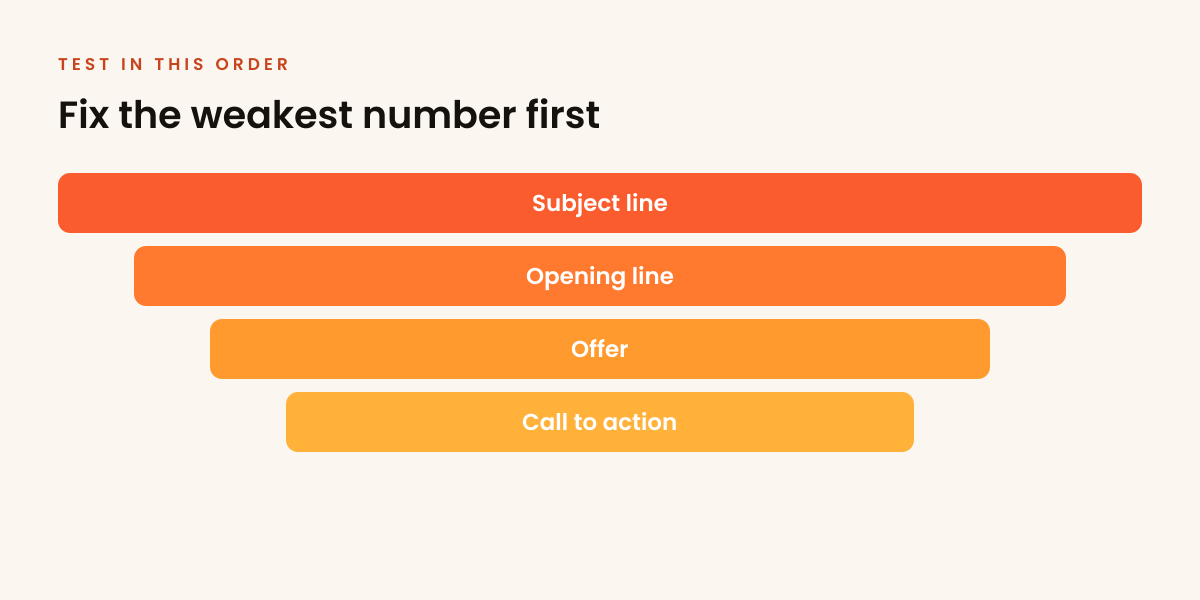
Fix the weakest number first
There is no point testing copy if nobody opens the email. Let the metrics point you at the problem:
One change at a time
This is the rule people break most. If you change the subject, the opening and the ask together and replies improve, you have no idea which one did it, so you cannot repeat it.
Changing one variable per test is slower and it is the only way the result means anything.
Volume decides whether it is real
A test on forty emails is a coin flip. One or two random replies swing the percentage completely, and you draw a confident conclusion from noise.
Meaningful tests need real volume behind each variant, which is another reason sending capacity matters beyond raw reach.
Measure the number the change should move
A subject test is judged on opens. A copy test is judged on replies. A call to action test is judged on how many replies turn into real conversations. Watching the wrong metric is how teams talk themselves into a change that did nothing, which is why it helps to judge every test against the same fixed set of outbound metrics worth reviewing every week.
What to test, in order of payoff
Not every variable deserves a test. Some move numbers by whole percentage points, others by decimals you will never detect at cold email volumes. Spend your testing budget where the leverage is:
- The offer. What you propose and how you frame the value. This is the highest-leverage variable in any B2B outbound campaign, and the one most teams never test because rewriting the offer feels harder than rewording a subject line. If no version of it lands, the issue may sit further back, in whether the offer is ready for outbound at all.
- The audience segment. Sending the same email to two different segments is a legitimate test, and it often reveals that the copy problem was a targeting problem all along.
- The subject line. Cheap to vary and quick to read out through open rates, but capped: a subject line fixes opens, not replies.
- The opening line. The first sentence decides whether the rest gets read at all.
- The call to action. Softer asks tend to lift reply rates; test whether they lift booked meetings too, because that is the number that pays.
- Send timing and length. Real but small effects. Test these last, once the bigger variables are settled.
A worked example: running one clean test
Say a campaign of 2,000 prospects has healthy opens but replies stuck near 1%. The bottleneck is the body, so the test targets the opening line. Variant A keeps the current version. Variant B swaps a company-focused opener for one built on an observation about the prospect.
Split the list at random, 1,000 per variant, and change nothing else: same subject, same offer, same ask, same sending schedule. After the full sequence has run, variant B sits at 2.1% replies against 1.2% for A. That is roughly 21 replies against 12, a gap large enough to act on at this volume. Variant B becomes the new control, and the next test starts from there.
What you gain is more than a better email. It is a fact about your market: openers built on observation beat openers built on introduction. That fact carries into every future campaign, which is the real return on disciplined optimisation.
Common A/B testing mistakes, and the fix
- Calling it early. Checking results after two days and picking a winner. Replies keep arriving for a week or more after a send finishes. Let the whole sequence run before you judge.
- Testing trivia. "Hi" versus "Hello" will not change your pipeline. Test changes a prospect would notice.
- Uneven splits. Variant A goes to the fresh half of the list, variant B to contacts collected a year ago. The test now measures list decay, not copy. Randomise properly.
- Ignoring deliverability drift. If one variant carries spam-prone phrasing, it can lose in the filters before anyone reads it. Watch bounce and spam signals alongside opens, as covered in our deliverability guide.
- Winner roulette. Declaring a winner, then rewriting the whole email next month and losing the gain. Winners become the control; future changes stay incremental.
Benchmarks: what a meaningful lift looks like
Start from your own baseline rather than a published average: take the reply rate your last comparable campaign produced, and if you have not run one yet, treat the first campaign as the exercise that establishes it. Against a base of 2%, a move to 2.2% across a few hundred emails is noise, while a move to 4% sustained over a thousand sends is a result. As a rough rule, trust lifts large enough to be obvious without a calculator at proper volume, and treat anything smaller as a hypothesis to retest. Our outbound benchmarks article covers what normal looks like across the rest of the funnel.
Testing across languages and markets
Running outbound across Europe adds a variable most testing advice ignores: language. A subject line that wins in English can fall flat in German, where buyers expect more formality and directness lands differently. We treat each language as its own testing track: a winner in one market is a hypothesis in the next, not a default. Where per-market volume is too small for clean tests, pool the learning at the level of structure, such as observation-led openers and a single ask, rather than exact wording. More on this in multilingual outbound.
It never really finishes
Audiences adapt and what worked last quarter fades. Testing is a habit rather than a project, and small, disciplined changes compound into a campaign that keeps improving instead of slowly decaying.
Frequently asked
What should I A/B test first in a cold email campaign?
Why should I only change one thing per test?
How much volume does a cold email test need?
Does spintax improve cold email deliverability?
What varies a cold email better than spintax?
How long should a cold email A/B test run?
Should both variants go to the same list?
Rather not build this yourself?
We run the targeting, data, copy and follow-up as a done-for-you service, and send the interested replies straight to your inbox. You bring the close.
Book a strategy call Or get a free target list first