


The cold calling script that sounds human
A cold calling script that does not sound like a script
The short answer
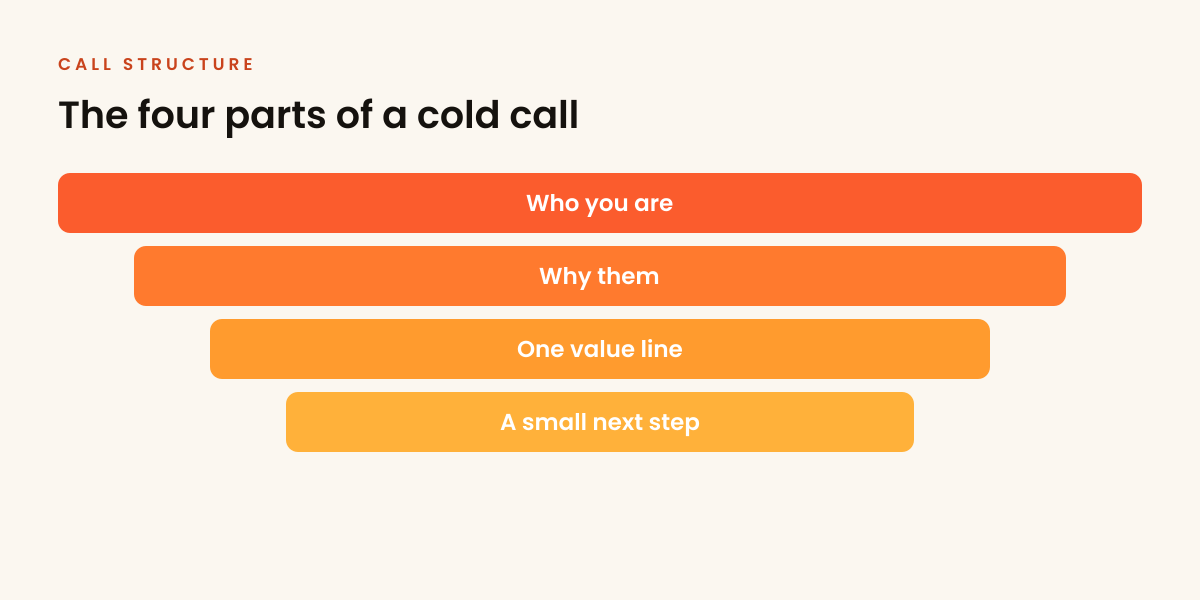
A script is a frame, not a text to read. Four parts: who you are, why them specifically, one line of value, one small next step. Read it aloud verbatim and it is audible within seconds.
A bad cold call is recognisable in three seconds: flat delivery, obvious reading, and a long introduction about the caller.

On this page
- The four-part script with an example
- A frame, not a paragraph
- Why them is the part that matters
- One line of value
- Ask for something small
- Expect the same four objections
- An example frame, part by part
- Delivery: the part no script can fix
- Common cold calling script mistakes
- Voicemail and gatekeepers are part of the plan
- When to call: windows, days and repetition
- Calling in Europe: language and formality
- Calls work best when they are not cold
The four-part cold calling script, with an example
Each part does one job and has one common mistake. The example lines are for a staffing agency calling a manufacturing firm.
| Part | Its job | Example | Mistake to avoid |
|---|---|---|---|
| Who you are | Name and side of the business, then stop | "Morning, this is Tomas from the agency side, we place industrial staff." | "How are you today?" and a company history |
| Why them | Answer the listener's question: why am I being called | "I noticed you have been advertising for CNC operators for the third month running." | A generic reason that fits anyone |
| One line of value | One sentence on a problem you credibly solve | "We fill exactly those roles for plants in your region, usually within a few weeks." | A list of services |
| Small ask | Agree a next step | "Worth a short call next week to see whether we can help with those roles?" | Asking for a lot on the first call |
The whole frame takes under thirty seconds when spoken. Which agencies run calling for you, and which countries still welcome it, is in the best cold calling agencies in Europe. For the choice between phone and email, read cold email vs. cold calling.
A frame, not a paragraph
The most important distinction. A script exists to stop you losing your place when someone asks something unexpected, not to be recited.
Rehearse it until you can say it in your own words. If it still sounds like text, it is not ready.
Why them is the part that matters
Within the first seconds the person is asking themselves why you are calling them. A concrete reason, their sector, size or situation, answers it. Without one, the call is over regardless of what follows.
One line of value
Not a list of services. One sentence about a problem you credibly solve for businesses like theirs. Attention on a cold call is short, and a long description spends it before you have earned any.
Ask for something small
The first call is not for selling. It is for finding out whether the topic is live and agreeing a next step. A short follow-up conversation, some information by email, a specific time. Asking for a lot on a first call gets a no by reflex.
Expect the same four objections
Almost every call meets "not interested", "no time" or "send me an email".
An example frame, part by part
Here is what the four parts sound like for a staffing agency calling a manufacturing firm:
- Who you are: "Morning, this is Tomas from the agency side, we place industrial staff." Full stop. No "how are you today", no company history.
- Why them: "I noticed you have been advertising for CNC operators for the third month running." One observable fact that explains why this person, today.
- One line of value: "We fill exactly those roles for plants in your region, usually within a few weeks."
- Small ask: "Worth a short call next week to see whether we can help with those roles?"
Spoken at a normal pace, that whole frame takes under thirty seconds. Everything after it is conversation, not script. The words will and should vary from call to call; the sequence stays fixed, which is what keeps you oriented when the other person takes the call somewhere unexpected.
Delivery: the part no script can fix
Two callers with the same script get different results because of pace, tone and pauses. The habits that separate them are learnable:
- Slow down the first line. Nervous callers rush the opening, which is exactly when the listener decides whether to stay on. The first ten seconds carry the whole call.
- Pause after the ask. Silence feels long to you and normal to them. Filling it with more talk walks back your own question.
- Stand up or sit straight. Posture changes voice. It sounds like folk wisdom until you hear recordings of the same rep both ways.
- Record and review. One reviewed call per day improves a caller faster than fifty unreviewed dials.
Common cold calling script mistakes
- Opening with permission theatre. "Did I catch you at a bad time?" invites a yes and hands over control before you have said anything. State your reason for calling instead.
- Pitching features. The prospect does not care what your service includes. They care about the problem it removes. Keep the value line about them.
- Answering objections with pressure. "Not interested" argued against becomes a hang-up. Acknowledged and met with one calm question, it often opens up.
- No planned next step. Calls that end with "I will send you something" and no agreed time mostly end there. Propose a concrete step before you hang up.
- Winging it on volume. Ten focused calls with research beat forty dials from an unqualified list. The script cannot compensate for calling the wrong people.
Voicemail and gatekeepers are part of the plan
A large share of dials never reach the decision maker, so the script needs two annexes. For voicemail, a short message that names the reason for the call and promises an email works better than a full pitch to a machine; we cover the structure in the cold call voicemail. For switchboards and assistants, honesty outperforms tricks: say who you are and why you are calling, and treat the gatekeeper as a person doing their job rather than an obstacle. There are workable approaches in getting past gatekeepers, and none of them involve pretending to be a returning call.
When to call: windows, days and repetition
Timing matters less than repetition, but it shapes the odds. Two windows come up consistently: early morning before the day fills with meetings, and late afternoon once urgent work is done. Midday is usually weaker, Monday morning is chaotic and Friday afternoon has already left. Treat these as tendencies to test, not rules.
Set expectations before judging a slot. Direct mobile numbers connect far more often than switchboard numbers, so measure them separately. Twenty dials tell you nothing about a window, so give each one a few hundred dials across two or three weeks, and compare connect rate and conversation rate separately.
One attempt reaches almost nobody, because people are in meetings, travelling or away. The same contact tried several times, at different hours and on different days, is reached far more often. A weekly cadence to test:
- Block two windows per day. One before 9:30 and one after 16:00, in the prospect's local time, protected in the calendar like meetings.
- Rotate windows per contact. Morning first, late afternoon second, midday a few days later.
- Space attempts. Two attempts on the same day irritates; two attempts four days apart does not.
- Cap the sequence. Five to eight attempts over three to four weeks, then move the contact to an email-only track.
- Leave one voicemail, not five. A single short message early gives later calls context.
Record every attempt and its time in the CRM, otherwise you call at the same hour repeatedly and get the same silence. Working hours also vary across Europe. German-speaking markets start early, so reaching a Geschäftsführer at 7:45 is normal, while many German offices empty out by 14:00 on a Friday. France protects the lunch break, so 12:00 to 14:00 is dead time. The Baltics run closer to 9:00 to 18:00, with Lithuania one hour ahead of Berlin.
Calling in Europe: language and formality
A calling script written for the US market travels badly, and so do its assumptions about what is permitted, since cold calling law in Europe varies by country. In German-speaking markets, the formal Sie is the default with strangers, first names come later, and a caller who is too casual too early loses credibility before the value line lands. In the Baltics and Poland, business calls tend to be short and to the point, and small talk reads as evasion. Calling in the prospect's native language changes pick-up-to-conversation rates enough that we staff campaigns accordingly: Ripe Leads runs outreach in the buyer's own language precisely because a fluent first sentence keeps the call alive. If you cannot call in the local language, lead with email in that language and reserve calls for prospects who replied, and pay attention to when you call: lunch habits and acceptable calling hours differ by country.
Calls work best when they are not cold
A call to someone who already saw your email or LinkedIn message lands very differently. Combining channels is what turns calling from a grind into a reasonable conversation, which is the point of a multichannel sequence.
Before you call UK companies, check the TPS and CTPS rule on the UK PECR and telesales page.
Frequently asked
What should a cold calling script include?
Should I read a cold call script word for word?
How long should a first cold call be?
How do I get past a gatekeeper?
Can a gatekeeper actually help me?
Why is the opening of a cold call so important?
How do I make a call warm instead of cold?
What is an example of a cold calling script?
What should the first cold call try to achieve?
What is the best time to make cold calls in B2B?
How many times should I try the same contact?
Rather not build this yourself?
We run the targeting, data, copy and follow-up as a done-for-you service, and send the interested replies straight to your inbox. You bring the close.
Book a strategy call Or get a free target list first