


The call to action: ask for less, get more
The short answer
The first email should ask for the smallest reasonable next step, usually a one-line answer rather than a meeting. One ask, phrased as a question, outperforms a calendar link plus a demo request plus a PDF.
On this page
- The goal is a conversation, not a close
- Small asks beat big ones
- One ask, not three
- Questions work better than commands
- Cold email call to action examples
- What the numbers say about smaller asks
- Common call to action mistakes
- If you think a calendar link saves friction
- How the ask should change across a sequence
- A note on tone for DACH and Nordic markets
- What happens after the yes matters too
Asking a stranger for 30 minutes is asking for a lot of trust you have not earned yet.

The goal is a conversation, not a close
A first cold email is not trying to win the deal. It is trying to find out whether the topic is relevant. Once that is the goal, a demo request at the bottom looks like what it is: several steps too far for someone who is still early in their own buying journey.
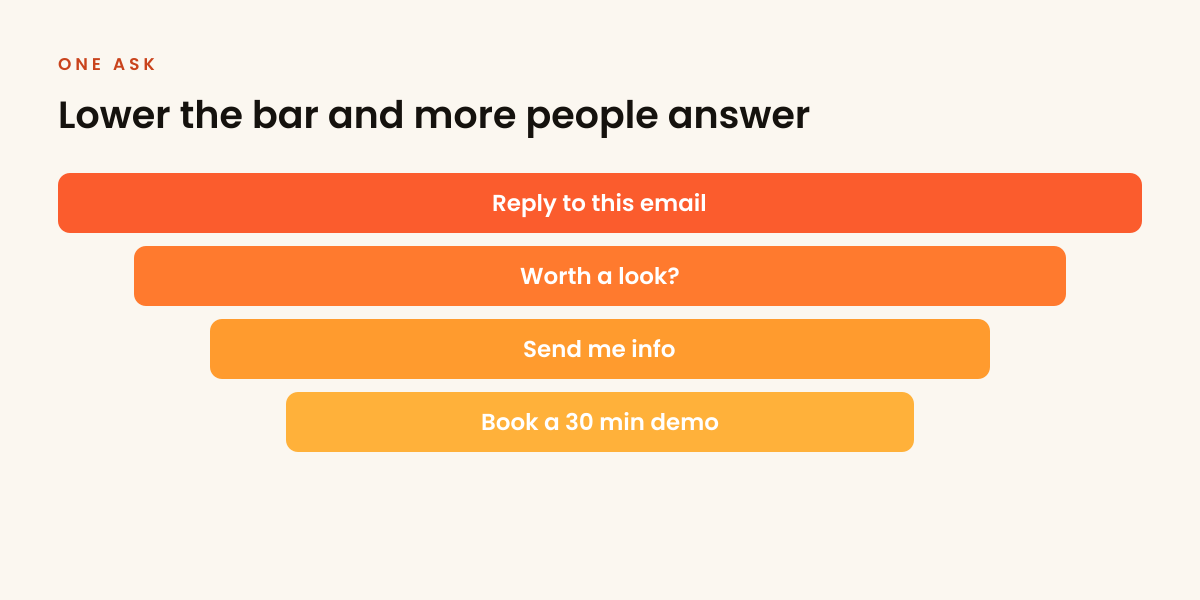
Small asks beat big ones
A question that can be answered in one line costs the reader almost nothing. A meeting costs them a calendar slot and the risk of a sales pitch.
"Worth a look?" gets answered. "Book 30 minutes here" gets ignored, then deleted.
One ask, not three
Every extra request lowers the response rate, because a reader forced to choose usually chooses nothing. Do not ask them to reply and click a link and book a slot. Pick the single lowest-friction yes and stop writing.
Questions work better than commands
A question invites an answer and keeps the exchange human. "Book a demo" is an instruction aimed at a prospect; "is this something you deal with?" is a message aimed at a person. People reply to people.
Cold email call to action examples
Concrete asks that fit a first touch, roughly in order of friction:
- "Is this on your radar at all?" A relevance check. One line to answer, no commitment implied.
- "Who looks after this on your side?" A routing question. Works well when titles vary and the wrong recipient can still forward you on.
- "Worth sending over a short breakdown?" Asks permission to share something useful, which turns the next email into a requested one.
- "Open to a 15-minute look at how this works?" The meeting ask. Fine later in a sequence, heavy in email one.
Notice what is missing: "book a slot in my calendar", "jump on a quick call", "schedule a demo below". Each of those asks a stranger to do your admin.
What the numbers say about smaller asks
Reply rates on cold B2B email are small numbers whatever benchmark you read, so every point matters. Within whatever range your own campaigns produce, the ask at the bottom moves results about as much as the subject line at the top. In the campaigns we run, interest-based questions beat direct meeting requests on first touch, and the replies they generate are easier to work with: a "yes, tell me more" gives you permission to sell, while silence gives you nothing. For context on what counts as good, see what a good response rate looks like.
Common call to action mistakes
- The triple ask. Reply, click and book in one email. Pick one.
- The vague close. "Let me know your thoughts" gives the reader nothing specific to answer. Ask a question with a one-line answer.
- The fake choice. "Does Tuesday at 2 or Thursday at 3 work?" reads as a technique the prospect has seen a hundred times, and it assumes a yes nobody gave.
- The apologetic ask. "Sorry to bother you, but if you ever have a spare moment..." buries the question in hedging. Direct and short is politer than grovelling.
- The mismatch. A well-researched, relevant email that ends with a generic demo pitch throws away the goodwill the first four sentences earned.
If you think a calendar link saves friction
The argument for pasting a booking link in email one: interested people can book instantly, no back-and-forth. The reality: a first email lands with someone who does not yet know whether they are interested, so the link reads as a demand, not a convenience. The link earns its place after a positive reply, when both sides have agreed a call makes sense. Used at that point it does remove friction; see booking link best practices and what to do when a prospect says yes.
How the ask should change across a sequence
The first email asks the smallest question. By the third or fourth touch the arithmetic has changed: the prospect has seen your name a few times, and a slightly bigger ask is now proportionate. A workable progression:
- Email 1: relevance question. "Is this something you deal with?"
- Email 2: add one proof point, repeat a low-friction ask.
- Email 3: offer something concrete: a two-line teardown, a benchmark, a sample.
- Email 4: the direct ask. "Open to a short call in the next two weeks?"
- Last email: close the loop politely and leave the door open.
A note on tone for DACH and Nordic markets
Casual asks translate badly into formal business cultures. "Worth a look?" works in London and Vilnius; in Germany, Austria and Switzerland the same brevity can read as flippant, especially in German with formal address. The principle survives translation, the phrasing does not: keep the single small ask, but phrase it with the courtesy the market expects. We write German campaigns with native copy for exactly this reason, and the same review applies to tone in every language a campaign sends in.
What happens after the yes matters too
A great call to action is wasted if the reply then sits unanswered for two days. Interest cools quickly, so the speed of your response is part of the call to action, not a separate concern. The same applies across a whole sequence.
Frequently asked
What is the best call to action for a cold email?
Why does asking for a demo in the first email not work?
Should a cold email have more than one call to action?
Rather not build this yourself?
We run the targeting, data, copy and follow-up as a done-for-you service, and send the interested replies straight to your inbox. You bring the close.
Book a strategy call